On a spring day at Texas A&M University’s Freeman Arena, the riders and horses were both wired. Not anxious. Literally wired. Small body sensors were attached to both horse and human so that a research team could measure something that had never before been quantified: exactly how the rhythmic movement of a horse synchronizes with the neural pathways of a rider with Parkinson’s disease. Soon, the data could help slow the progression of this degenerative condition that affects balance, gait and motor control.
The results surprised even Dr. Deanna Kennedy ’15, an associate professor in the Department of Kinesiology & Sport Management, who was heading the research in partnership with Courtney Cares, the university’s equine-assisted service program. After just one 45-minute session on horseback — involving activities such as figure-eight patterns and stop-and-go exercises — the Parkinson’s participants showed measurable improvements in balance and a reduced risk of falling.
“We’re hoping that equine-assisted therapy will be a game changer in how we treat Parkinson’s,” said Kennedy, who is looking to secure funding for more research in the field. “If you think about it, we’re all aging, so we all have an interest in this.”
The Parkinson’s research represents Courtney Cares’ most recent effort to advance treatment and improve lives. Since 2012, Courtney Cares — officially known as the Courtney Grimshaw Equine Therapeutic Program — has used horses from Parsons Mounted Cavalry to help children and adults with mental and physical impairments as well as veterans experiencing PTSD. After years of uncertainty, the program has found a permanent home and a champion with an ambitious plan to position the university as a national leader in equine-assisted services.
Reshaping the Industry
Last year, Courtney Cares moved to the Texas A&M Institute for Equine Sciences under Texas A&M AgriLife Research. “Texas A&M has tremendous resources to pour into this program, including an Aggie Network that gets the humanity at the heart of it,” said institute director Craig Huffhines ’90, who has previously worked as an executive at the American Quarter Horse Association. “I mean, horses healing humans is a beautiful thing.”
Huffhines has a strong partner in extolling the benefits of equine-assisted services. Dr. Nancy Krenek heads a nonprofit therapy service called ROCK (Ride On Center for Kids) in Georgetown, Texas, and has long served as the executive director of Courtney Cares. “My dream is for Texas A&M to lead our state and nation in equine-assisted services,” she said. “Affiliating Courtney Cares with the Institute for Equine Sciences gives us a strong push in that direction.”
With the backing of a $10.5 million fundraising campaign, Courtney Cares has the chance to expand beyond its role as a beloved local program. The institute is meant to be a hub connecting all equine activities with other colleges, such as engineering and medicine, and is responsible for sharing knowledge and experience industry wide.
Krenek, who calls Courtney Cares “this little shining diamond” in the Texas A&M firmament, has watched equine-assisted therapy evolve from alternative treatment to what she calls a field that’s “finally sexy.”
“We plan to expose people to Courtney Cares to have the conversation about how to run equine-assisted service facilities,” explained Huffhines. “What does it cost to run them? How do nonprofits come together and formulate a business model that will be sustainable? What are the practices from a science standpoint that get the best results with a particular person’s needs?”
The institute will also use research, such as the Parkinson’s results, to convince insurance companies, Medicare and legislators to accept these types of treatments. Colorado has already passed legislation allowing Medicare to fund equine-assisted therapy, largely due to work done with autism research. Beginning in 2027, Illinois will also require insurance providers to cover medically necessary equine-assisted services. “We’re not there yet here in Texas,” said Huffhines, “but that’s something we need to work toward.”
The funding campaign’s goals include $200,000 yearly for an equine-assisted services professorship, $110,000 for a program coordinator and $90,000 for maintaining a permanent population of 20 therapy horses. The first $5 million would ensure the current program’s survival; the second $5 million would fund expansion and additional faculty.
Opening Minds and Hearts
It doesn’t take long for people outside the equine-assisted therapy world to grasp the potential and magic of the horse-human connection. Students who take the Equine-Assisted Activities and Therapies course at the College of Veterinary Medicine & Biomedical Sciences must volunteer with Courtney Cares as part of their lab work. In surveys following the course, many describe their experience in terms akin to this student’s review: “This was the first and only class I took during four years of undergraduate studies where I wasn’t just learning. I was really making a difference.”
Donors who discover Courtney Cares often find themselves similarly moved. “I’m a 59-year-old former member of the Corps of Cadets, and I cried more than you could possibly imagine,” admitted Teddy Peinado ’88, referring to his viewing of a documentary, “Where the Horses Heal the Soul,” that features Courtney Cares. Peinado, whose company supports veterans’ causes, felt compelled to contribute. “The amazing transformation that equine-assisted services can bring to these people — really giving them a life back — just gripped me.”
For Lynette and Darnell Knippa ’70 of Yoakum, Texas, the decision to support Courtney Cares came through peer testimonies and after meeting program participants in person. “We have so many friends who are horse people who can attest to how beneficial horses can be in the healing process,” Lynette explained. The collaboration with Parsons Mounted Cavalry to use disciplined, cannon-firing-resistant horses for therapeutic purposes added another layer of appeal. “I just thought that was brilliant, putting those two programs together.”
Gabriel Knopp (left) has been a longtime participant of Courtney Cares, while Grace Forehand ’25 (right) took a Texas A&M University class that included hands-on volunteering with the program. Photos by Elizabeth Lavin (left) and Paige Rains with special thanks to Troy Compton Performance Horses (right).
Kay Pence, a longtime supporter, acknowledged the ancient wisdom behind Courtney Cares. “Even the Greek physician Hippocrates referred to the value of horseback riding in physical recovery,” she noted. “This is nothing new. We just need to recognize and promote this treatment.”
For Krenek, the wide application of equine-assisted therapy is most compelling. “Most people, at some point in their life, will encounter someone who could benefit from equine-assisted services,” she said. With Texas A&M’s help, that encounter might just become transformative.
The Volunteer Who Found Unbridled Joy
When she was growing up in Beaumont, Texas, Beth Bohne’s father encouraged her interest in horses and particularly her passion for show jumping. Every weekend morning, he would drive her to early riding lessons and attend her shows. He even made a wooden equipment box for her brushes and hoof pick that she still cherishes today. “Horses connected us,” she said.
But when she was 15, her father died of cancer, and she found that horses still had a significant role to play: They helped her cope. “You develop such a bond with this animal,” Bohne recalled. “And they basically tell you, ‘Look, lady, you need to relax. I’m a nervous wreck because you are.’” For a small girl — just under 5 feet — navigating profound loss, that relationship became essential. “In a lot of areas, the horse filled in the blanks for me.”
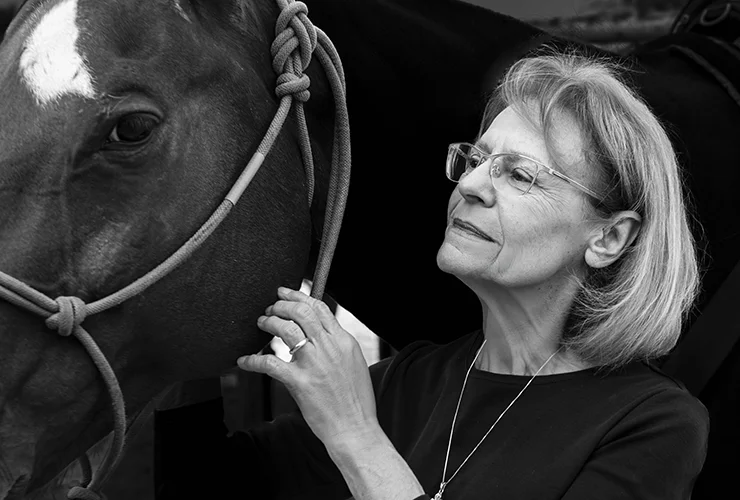 As a volunteer with Courtney Cares, Beth Bohne witnessed incredible progress in participants, from children with muscular issues to veterans with PTSD. Photo by Elizabeth Lavin.
Decades later, when her husband, Dr. Henry “Hank” Bohne ’72, a general surgeon recruited into military service at age 57 during the Iraq and Afghanistan wars, learned about a new equine-assisted therapy program called Courtney Cares, he suggested his wife investigate volunteering with it. From her first day at Freeman Arena in 2012 when she watched disabled children on horseback, she knew she had found a mission.
Every aspect of my life was brought together in that arena.
“Every aspect of my life was brought together in that arena,” Bohne said, referring to her love of horses, her nursing background, and her understanding of military service born from having a veteran husband and two military sons. Initially, she served as a side walker and horse leader, working directly with clients in the arena. As the program grew and pursued certification with the Professional Association of Therapeutic Horsemanship International, Bohne transitioned to office work, organizing paperwork and coordinating meals for veteran participants.
Over the years, she watched children with muscular issues or veterans with PTSD arrive tense and leave relaxed after a session with the therapy horses. But just as rewarding for her was observing how the children’s parents and family reacted to the progress they witnessed. “It was a new aspect of treatment for their child that they’d never been exposed to before. And when your child is having a good experience, it just warms your heart,” she said. “I saw kids who were nonverbal open up and actually answer a question from the therapist. Even if it’s just one word, it’s an accomplishment. It may not sound like a lot to you or me, but for these clients and their families, that’s a big deal.”
After eight years of dedicated service, Bohne stepped back from regular volunteering to spend time with her five grandchildren living both in the U.S. and Germany. But she still finds ways to be involved, such as giving a cherished pony of hers named Goodness to an equine center she’d come to know through Courtney Cares. “Goodness has such a good nature,” she said. “I’ve enjoyed her. And now it makes me so happy to know she’s helping someone else, the way horses once helped me.”
The Veteran Who Found Peace in the Saddle
Lt. Col. John Fleming ’94 believed he had it all figured out when he walked into Freeman Arena to participate in a Courtney Cares program for veterans. After 20 years in the Marine Corps, including three combat deployments to Iraq and Afghanistan, he thought he’d share his leadership experience and maybe learn a few riding skills along the way.
“I thought this would be a great place for me as a retired lieutenant colonel to mentor some veterans,” Fleming recalled. “What I found was completely different.”
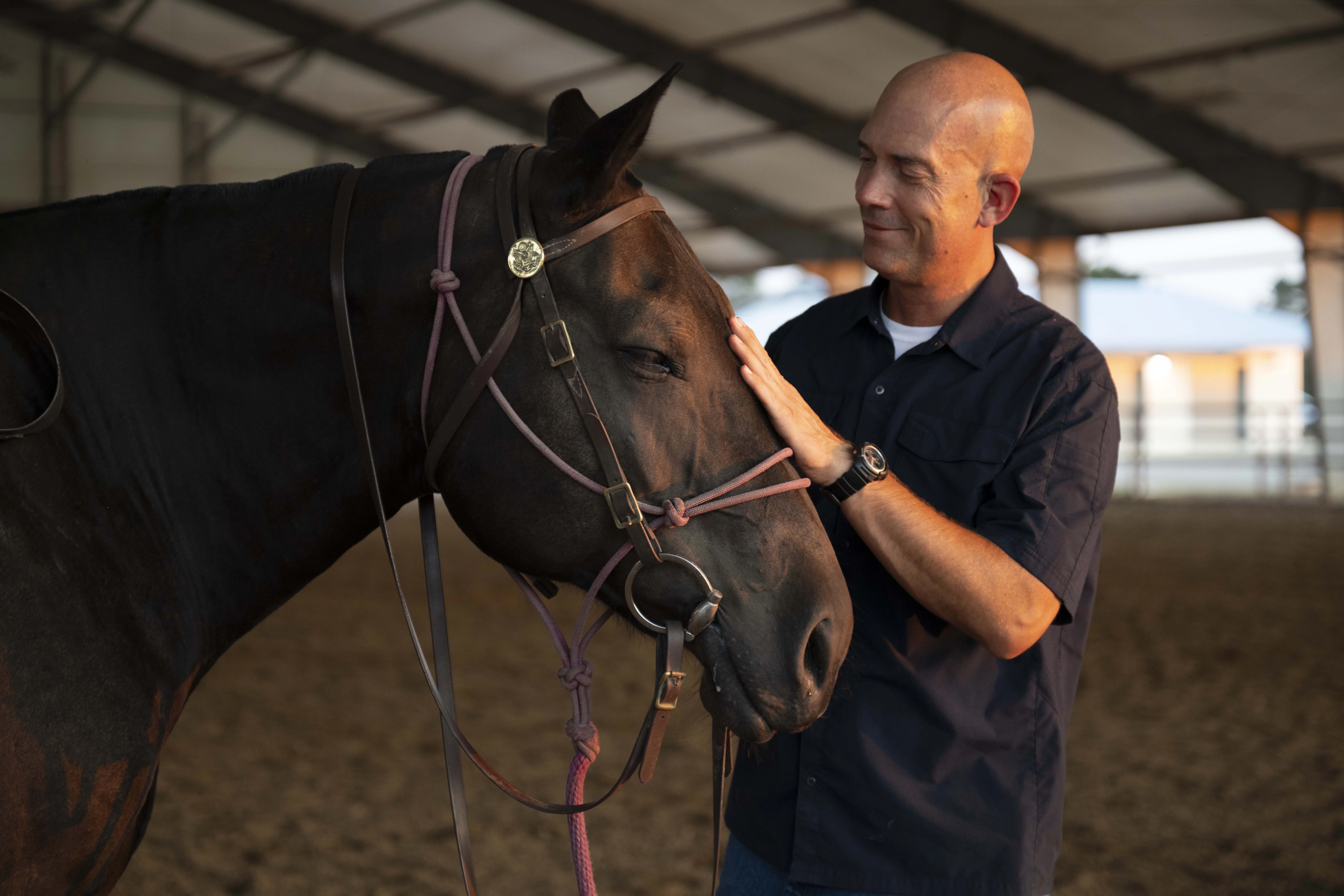 By offering a safe place to reflect, grow and find inner peace, the arena has helped Lt. Col. John Fleming ’94 navigate returning to civilian life. Photo by Elizabeth Lavin.
Fleming discovered that horses don’t care about rank. They don’t salute or follow orders. Instead, they respond to something much more fundamental: the energy and emotional state of the human standing beside them.
“A horse knows more about you than you know about yourself,” Fleming explained. “If you’re stressed, you can put on a smile for all the other humans. They’re not going to know what’s going on inside, but a horse can feel those things.”
A horse knows more about you than you know about yourself.
This was unsettling territory for Fleming, who had successfully navigated military challenges after graduating from Texas A&M in 1995, such as handling the complex choreography of keeping Marines supplied and moving and commanding a company in Fallujah during the Iraq War.
But leaving active duty in 2015 proved more unsettling than any deployment. “The military is all I ever knew,” said Fleming, whose father served 30 years in the Air Force. After leaving the Marines, he bounced between jobs for two years before he landed a position as a training officer with Texas A&M’s Corps of Cadets. Aware of Fleming’s struggles to find his footing in civilian life, his wife, Amanda ’94, a Courtney Cares volunteer, suggested he consider its veterans program.
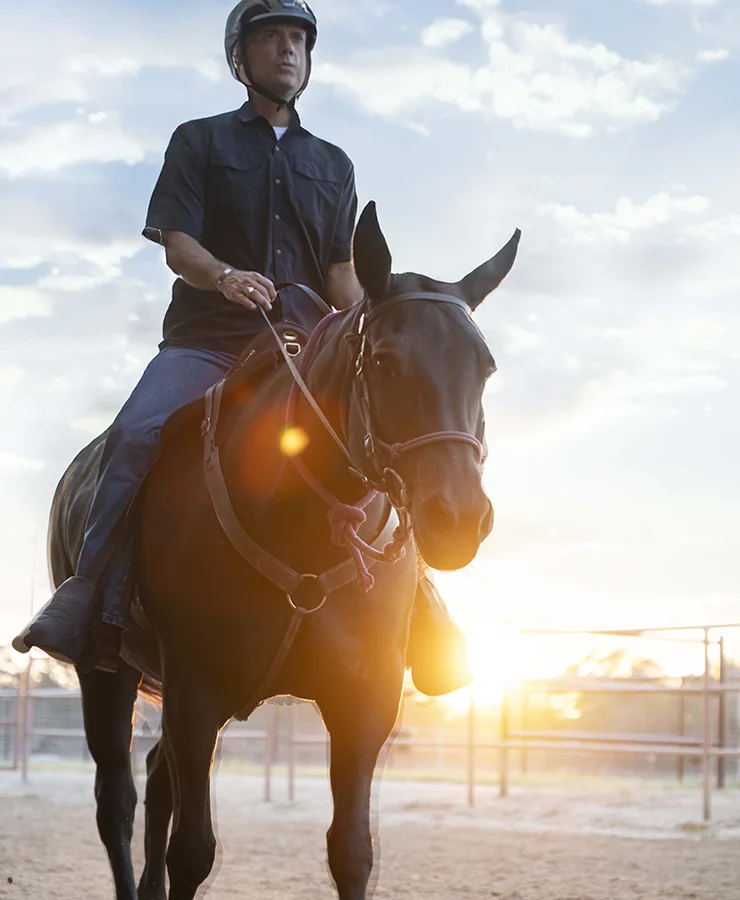 At its core, equine-assisted therapy works because horses are incredibly sensitive to human emotions and energy. Photo by Elizabeth Lavin.
What Fleming wasn’t ready for was how the horses would expose internal struggles he didn’t know existed. Paired with a particularly challenging mustang named Simmie, he recalled: “I just couldn’t get him to respond favorably to me.” The instructors told him he needed to find peace inside before he could connect with his horse. “It really taught me a lot about how to deal with what was going on inside my own head.”
The program forced Fleming to confront experiences he thought he’d processed years earlier. In 2005, Fleming was a company commander in Fallujah when a devastating bomb attack on a convoy of mostly female Marines killed several and wounded more, two of which were members of his company.
“I went forward after that terrible event; I slept at night,” Fleming said of the immediate aftermath. But years later, unexpected triggers would bring it all flooding back, including watching his own daughter navigate teenage independence. At a Marine Corps ceremony, the sound of a female platoon marching caused him to break down. “Right there in front of everybody,” he said. “I didn’t realize that the incident in Fallujah had affected me as much as it had."
Courtney Cares has taught him to recognize when stress is building before it becomes overwhelming. What he’s learned “carries over to life too in terms of just being in control and being a better husband, a better father and a better teammate at work,” he said.
For Fleming, who now directs the Don & Ellie Knauss Veteran Resource & Support Center at Texas A&M, the arena has become a place of honest self-reflection, where a thousand-pound animal serves as both mirror and teacher. “You really have to examine yourself and be at peace to be successful with that animal,” he explained. “That’s the magic dust for this program.”
The Student Who Found Her Herd
Grace Forehand ’25 was the girl with a horseshoe hanging on her bedroom wall and a poster of a horse gazing down at her each night. “In my mind, I owned a whole herd of horses,” she said with a laugh, remembering her childhood in Oklahoma.
Despite her lifelong fascination with horses, which in real life was limited to occasional riding lessons at summer camp, Forehand never imagined this passion would intersect with her college studies. That changed during her sophomore year at Texas A&M when she spotted something intriguing while watching TV: a show featuring equine-assisted therapy.
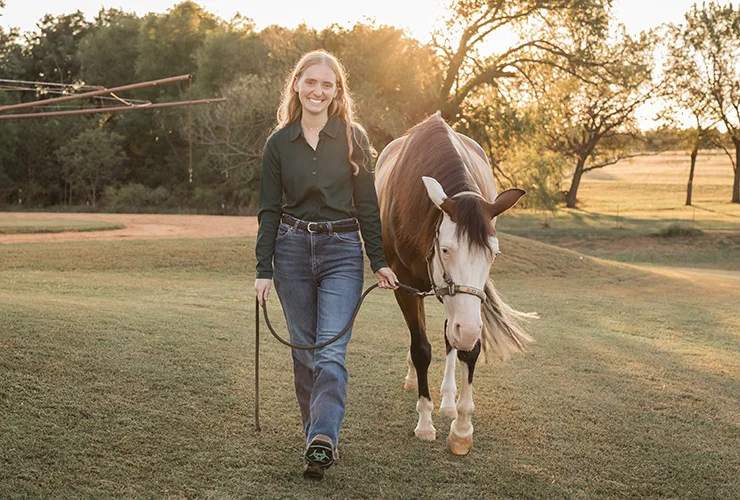 After volunteering with Courtney Cares while at Texas A&M, Grace Forehand ’25 is pursuing graduate education and hopes to become a licensed equine-assisted therapy instructor. Photo by Paige Rains.
“When I Googled equine therapy, I saw that Texas A&M offered a biomedical sciences course on the subject,” Forehand recalled.
Her casual curiosity led to one of the most transformative educational experiences of her undergraduate career. The class, taught by Dr. Priscilla Lightsey ’80 and Dr. Nancy Krenek, combined traditional classroom learning with hands-on volunteering at Courtney Cares, where students worked directly with participants who have physical or mental disabilities.
For Forehand, the learning curve was steep but rewarding. “A lot of students had never touched a horse,” she explained. “But the professors made the class very engaging.”
The professors didn’t just teach about equine-assisted therapy; they fundamentally changed how students viewed people with disabilities. “One of the first lessons they taught us was when somebody has a disability, we put them in a box,” Forehand said. “I learned how to break out of that kind of thinking and just see the person before the disability.”
It is my dream to own my own land and at least one or two horses where I can offer therapy sessions.
What started as a single elective became a three-year commitment. Forehand volunteered for multiple sessions each week, eventually earning an equine science certificate and training new volunteers. She witnessed remarkable transformations in the participants she worked with, including one teenager who progressed from needing significant assistance to riding independently.
“When I first met him, he either relied on us to lead the horse or he wouldn’t hold the reins for long because of issues with the leather’s texture,” Forehand explained. “By the end of my time with him, he was riding independently. It made me so happy.”
Now headed to the University of Oklahoma for a master’s in clinical mental health counseling, Forehand plans to pursue certification with the Professional Association of Therapeutic Horsemanship International to become a licensed instructor. Her ultimate goal? Combining her psychology training with equine-assisted therapy to help veterans with PTSD, an interest that grew directly from her Texas A&M classroom research.
“It is my dream to own my own land and at least one or two horses where I can offer therapy sessions,” she said, her voice brightening.
The Participant Who Embraced the Reins
Gabriel Knopp’s world began to change in the waiting room at a music class in College Station, Texas. That’s where his mother, Kim ’01, had a chance meeting with Donelle Beal, the program director at Courtney Cares, while their daughters practiced their instruments in another room.
Gabriel, age 6 at the time, had been born seven weeks prematurely and was diagnosed with autism at age 3. “His cognitive ability has always been at or above age level. He is very bright,” explained Kim. “But he has difficulty expressing himself verbally despite understanding everything around him, which leads to a lot of frustration.”
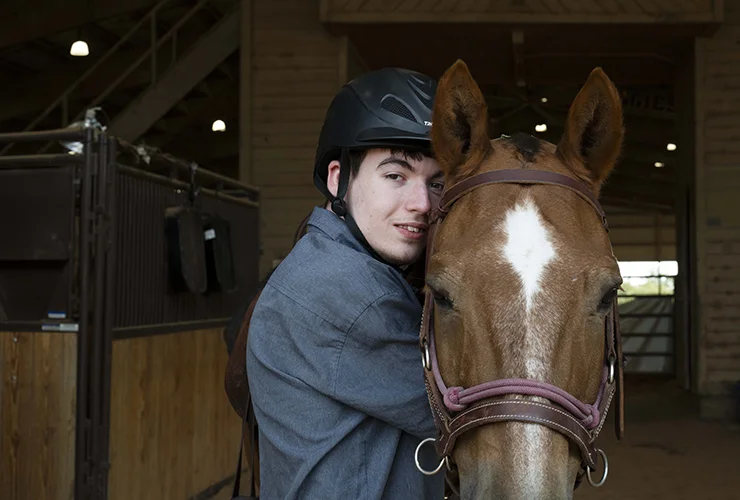 Courtney Cares has helped longtime participant Gabriel Knopp gain confidence, social skills and greater comfort in expressing himself. Photo by Elizabeth Lavin.
In the waiting room, Beal approached Kim and explained how Courtney Cares could help her son. Gabriel, now 18, has been riding with the program longer than any other participant — a distinction that fills his parents with pride and amazement. “It has been one of the biggest blessings for him,” Kim expressed.
The changes began almost immediately after Gabriel first mounted a therapy horse. He had been struggling in occupational therapy with crossing over the midline, or using his right hand to reach across to the left side of his body, an exercise that engages both sides of the brain. When Beal incorporated this movement into Gabriel’s horseback riding routine, his occupational therapist noticed improvement within weeks.
“It was a significant change,” Kim said. The riding helped strengthen Gabriel’s core muscles, which had been weakened by abdominal surgery when he was young. “He had to sit up straight and control the horse and control his body movement.”
But perhaps more remarkable has been Gabriel’s social development. He has blossomed through his interactions with volunteers, mostly Texas A&M students, and the horses themselves. “When he was younger, he had a hard time speaking to people,” explained his father, Darren. “Courtney Cares allowed him to interact with a lot of different people, become comfortable with others, and then speak and express himself.”
What makes the program special, Kim believes, is that “animals don’t judge. They don’t look at you differently for anything that is different about you.” This non-judgmental environment has allowed Gabriel to build confidence and develop skills that transfer to other areas of his life.
He blossomed and matured mentally, physically, emotionally and socially.
Now approaching adulthood, Gabriel continues his education through homeschooling and still participates in Courtney Cares. His parents credit the program with helping him develop the social skills and confidence he’ll need as he transitions to greater independence.
“I don’t think he would be where he is now developmentally without this program,” Kim said. “He blossomed and matured mentally, physically, emotionally and socially. We were in the right place at the right time when we learned about Courtney Cares.”

Send Message to Jansen
Thank you for submitting a contact form!
Contact form was unable to submit.