History has long remembered the brilliant minds who impact humanity — those scientists, inventors and academics who advance their fields and change the world through their discoveries. Imagine the impact on Texas A&M University if Aggieland’s faculty and students could collaborate with today’s history makers.
That’s exactly what the Hagler Institute for Advanced Study has been doing for over a decade.
Launched in 2012, the Hagler Institute invites today’s leading scholars from across disciplines to campus for up to 12 months, though this period can be spread out with visits over five years. These visiting scholars, known as Hagler Fellows, lend their extensive expertise by presenting lectures and collaborating closely on research with up-and-coming Texas A&M faculty and graduate students.
Nominated by faculty and selected by a cross-disciplinary panel, Hagler Fellows must be National Academy-level professionals and have a proven record of mentorship. To date, the institute has hosted 135 Fellows who have collaborated with faculty and students from nine Texas A&M colleges and schools and counting. Among their ranks have been six Nobel Prize winners and those with notable contributions and accolades too lengthy to list.
“The caliber of people we select jumps off the page,” said Dr. John Junkins, the institute’s founder and director. “But they know that their most important career outcomes are not their personal accomplishments. Rather, these Fellows understand that through teaming with bright young faculty and students, their impact can truly become immortal by inspiring and educating the next generation.”
Recognizing the power of this program, donors — including faculty like Junkins — have stepped up to ensure this impact only continues to grow. Most recently, the Robert A. Welch Foundation pledged a $10 million gift to create chairs for Fellows in chemistry-related fields. This gift was augmented with university funds and $5 million from Jon Hagler ’58, who had previously named the institute with a lead endowment in 2017.
Beyond its impact on collaborating faculty and students, the institute has boosted the university through the 16 Fellows who have become permanent faculty, in turn motivating many other accomplished colleagues to join them. Since 2011, the number of National Academy members at Texas A&M has increased from 11 to approximately 60, an unparalleled growth supported in part by the Hagler Institute. “The Hagler Institute will continue elevating ambitious programs at Texas A&M in ways that can only be imagined,” Junkins said.
“It’s hard to like what you don’t know,” said Dr. Theodore Rappaport, a 2024-25 Fellow. “Through the Hagler Institute, you get to know and like Texas A&M and the incredibly talented people here, including students I can mentor throughout their careers.”
Meet a few 2024-25 Fellows like Rappaport whose history-shaping discoveries exemplify the outstanding brilliance the Hagler Institute brings to Aggieland.
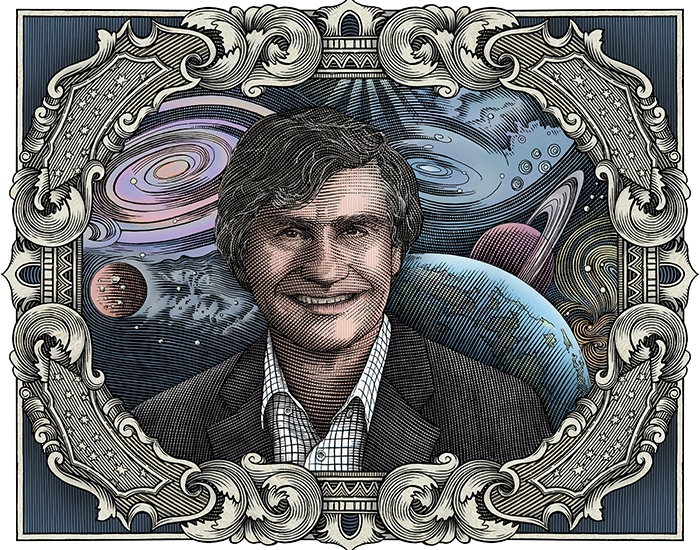 Dr. Alexei Filippenko is an awarded astronomer who studies supernovae and the universe's expansion.
Discovering an Expanding Universe
Dr. Alexei Filippenko
Distinguished Professor of Astronomy, University of California, Berkeley
Since the dawn of the universe, space and the energy within it has been continually expanding. For years, scientists thought that this expansion rate must be constantly decelerating as the universe continues to age, slowed down by the attractive force of gravity.
Dr. Alexei Filippenko is one of the scientists who helped change that view. In 1998, two teams of researchers, including Filippenko, used a technique that involved comparing the brightness of exploding stars, or supernovae, to make an earth-shattering discovery: Rather than slowing down, the universe is actually expanding at an accelerating rate. The discovery was heralded by Science magazine as the most important scientific discovery of 1998, and the leaders of the two teams later received the 2011 Nobel Prize in Physics.
“Announcing the results of our data was one of the most exciting moments of my career,” Filippenko said. “Our view of the universe had changed in a fundamental way.”
Today, Filippenko is still tackling some of astronomy’s biggest questions by seeking to better understand this expansion rate and address discrepancies among differences in the measured rate. During his time as a Hagler Fellow, he’s collaborating closely with Texas A&M astrophysicists on this question, as well as projects studying the properties of supernovae.
In line with the Hagler Institute’s emphasis on mentorship, Filippenko is also devoted to fostering an interest in science among the next generation and has given more than 1,500 public talks throughout his career to people of all ages. “Discoveries in astronomy excite kids to enter STEM fields,” he said. “If astronomy can inspire them to enter fields like computer science, engineering, applied physics or medical physics, that will be immensely beneficial to society.”
 Dr. Theodore Rappaport is a pioneer in wireless communications whose research laid the foundation for Wi-Fi and modern 5G technology.
Inventing a Better Way To Communicate
Dr. Theodore Rappaport
David Lee/Ernst Weber Professor of Electrical Engineering, New York University
At 5 years old, Dr. Theodore Rappaport was enthralled by his grandfather’s shortwave radio and spent hours tuning the dial to pick up Morse code and ship-to-shore communications. Today, thanks to his research, that same magic of wireless communication has become an essential element of everyday life.
Rappaport has been at the leading edge of wireless research since his Ph.D. work in the 1980s, which was the first to study how radio waves move through buildings at a time when computers, cash registers and other technologies still used ethernet cables. This work became the basis for the first wireless LAN system, which evolved into the Wi-Fi that today connects everything from cell phones to thermostats.
Beyond this discovery, Rappaport has also earned the title “the father of 5G millimeter wave” through his work in exploring higher-frequency waves to carry cell phone signals. Previously, phones operated on waves that were lower frequency, below six gigahertz. When Dr. Rappaport and his team at New York University demonstrated that waves at 10 times the frequency could effectively carry these signals, they were adopted in the fifth generation of cell phone technology standards, better known as 5G.
“Before 5G, if you tried to send a photo in a crowded stadium, it would bring the network to its knees because the existing frequencies didn’t have enough capacity to serve everyone,” Rappaport explained. “5G opened up a new frequency band to better accommodate demand, so now, even if you’re at an Aggie football game, everyone can still get fast download speeds.”
And Rappaport already has his sights set on 6G and 7G technologies to continue improving our wireless world. “The ability to communicate anytime and anywhere is fundamental to the fabric of humanity,” he said. “That’s what mobile communication is all about.”
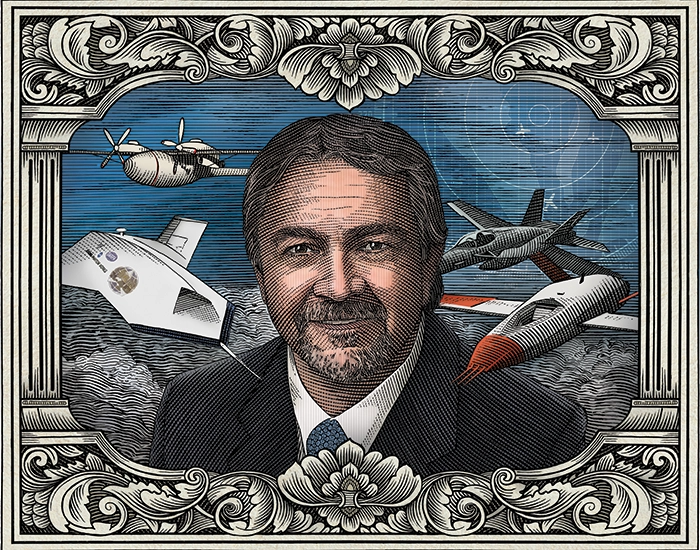 As chief architect of Boeing’s autonomous aircraft programs, Dr. Kevin Wise has helped develop countless innovations in the defense industry.
Shaping Advancements for Smarter Aircraft
Dr. Kevin Wise
Distinguished Senior Technical Fellow and Vice President, The Boeing Company
Imagine if the flying cars we’ve been seeing for decades on the silver screen were real. You could live farther from the hustle and bustle of the city while still reducing your daily commute as you leave congested roadways on the ground. Then, your car could fly itself home and return to pick you up when you clock out.
This stuff of science-fiction is closer to reality than ever thanks to autonomous systems like those developed by Dr. Kevin Wise. As the chief architect of Boeing’s autonomous aircraft programs, Wise has focused his 43-year career in the aerospace industry around building safer, smarter ways to control aircraft, both through autonomous systems and optimal flight control systems.
His work has led to countless innovations in the defense industry and become the standard for weapons programs. One such project, the X-45A Joint Unmanned Combat Air System, debuted an autonomous system that allowed one operator to control four jets at once. “This was a transformational program for the Air Force,” Wise said. “It demonstrated the power and flexibility autonomous systems can achieve during some of the most dangerous missions.”
That technology later became the foundation for other defense aircraft Wise’s team has developed, including the Phantom Eye — a communications and reconnaissance craft that can fly for days before refueling — and the U.S. Navy’s first carrier-based unmanned aircraft, the MQ-25A Stingray.
Looking to the future, Wise is confident autonomous systems will continue to advance, and he points to the multiple companies that are already testing autonomous air taxis as a prime example of the field’s potential. “The industry has never been more exciting,” he said. “I tell students that there’s no better time than now to help change the world.”
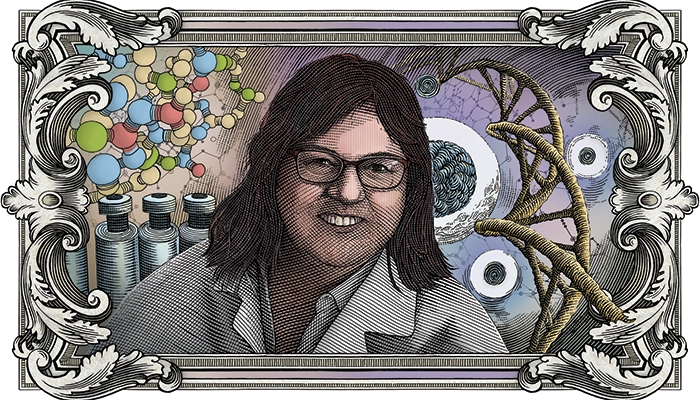 With a career spanning industry, academia and global health, Dr. Mary Pat Moyer is advancing regenerative treatments for neurodegenerative diseases.
Developing a New Treatment for ALS Patients
Dr. Mary Pat Moyer
Founder, CEO and Chief Science Officer, INCELL Corporation
Adjunct Professor, University of Texas Health Science Center at San Antonio
In 1939, Lou Gehrig was one of the most famous baseball players around, hitting for the New York Yankees for an incredible 17 seasons. But his illustrious career was cut short when he was diagnosed with amyotrophic lateral sclerosis (ALS), a neurodegenerative disease that causes loss of muscle control. It’s the same disease that kept Stephen Hawking in a wheelchair for much of his life.
Improving quality of life for patients with this and other neurodegenerative diseases is Dr. Mary Pat Moyer’s mission. Her company, INCELL Corporation, is at the cutting edge of regenerative medicine through its unique cell tools that combine stem cells with a patient’s own immune cells to revitalize them. Their potential treatment for ALS has already seen exciting results in the trial’s main patient. Before treatment, he couldn’t walk or hold a pen, but after starting trials, he can now move from his wheelchair to his bed, write his name and even do squats.
“What excites me most and what keeps me up at night are the patients who need what we’re doing,” Moyer said. “A cure probably isn’t possible at this point, but we’re only at the beginning of improvements in care.”
A virologist by training, Moyer’s 57-year career has spanned both industry and academia and included work for the World Health Organization. She was also the first woman and Ph.D. faculty at The University of Texas Health Science Center at San Antonio’s Department of Surgery.
But one of her proudest accomplishments is being what she calls a “pebble in the pond,” referring to the ripple effect of impacting countless students who are now helping others. It’s something she’s eagerly continuing as a Hagler Fellow by sharing her industry experience with faculty and students. “That’s one of the beauties of being a Hagler Fellow,” she said. “It lets you be a pebble in the pond in a way that makes a difference.”

Send Message to Steve
Thank you for submitting a contact form!
Contact form was unable to submit.