It’s always a flurry of activity in Texas A&M University’s College of Performance, Visualization and Fine Arts (PVFA). But one week last November, the flurry was a full-on creative storm.
That week, the talent and artistic offerings of PVFA students and faculty were on full display through nearly 20 events that spanned every area of the college.
One day, students in the dance science program performed new choreographic works for two sold-out shows, rotating, leaping and swaying in dances ranging from graceful ballet to high-energy jazz.
The next, the performance and visual studies program, in conjunction with a film studies course, screened a documentary about student activism at Columbia University. Following the film, students participated in a lively discussion on the aesthetics of activism and the documentary’s rhetorical strategies.
Over in Rudder Theatre, characters in colorful costumes commanded the stage for the theatre program’s second original production, “The Post-America Variety Show.” The characters sang, danced, told jokes and had the two performances’ sizeable crowds laughing, calling out responses and even doing a little jazzercise.
Last fall, the theatre program presented “The Post-America Variety Show,” a devised theatre production about a group of performers in a post-apocalyptic future (left). The weeklong Crescendo showcase featured 14 performances put on by the music performance program, which attracted listeners from across the Aggie community. (Photos by Justin Kling/PVFA)
All week, the air was thick with music as students from the music performance program showcased their talents in the program’s inaugural showcase, Crescendo. Peacefully plinking pianos, jubilantly blasting horns, vibrantly clanging steel pans, cheerfully whistling woodwinds — all serenaded listeners through 14 student performances at the Liberal Arts and Humanities Building and the Rudder Theatre Complex over five days.
And that’s not even mentioning the visualization talks and workshops sprinkled throughout the week, where students could hear from design experts and grow their skills in turning ideas into vibrant reality.
Though some of the week’s events were more classic representations of the arts, others — including an experimental and electronic music performance and a showcase that combined music with interactive visuals — weren’t your average arts presentations.
But then, the College of Performance, Visualization and Fine Arts isn’t your average arts college. Like everything in Aggieland, it’s embracing innovation to ensure that its students are prepared to meet the needs of an ever-evolving industry head-on. With an interdisciplinary focus and technology at its core, the college takes a new approach to the arts, one designed to make Texas A&M an institution that doesn’t just contribute to the arts but also leads the industry into the future.
Assembling the Players
Established in fall 2022, PVFA was created to unite the university’s artistic disciplines under one roof and infuse them with a technological focus to prepare students for the arts of the 21st century.
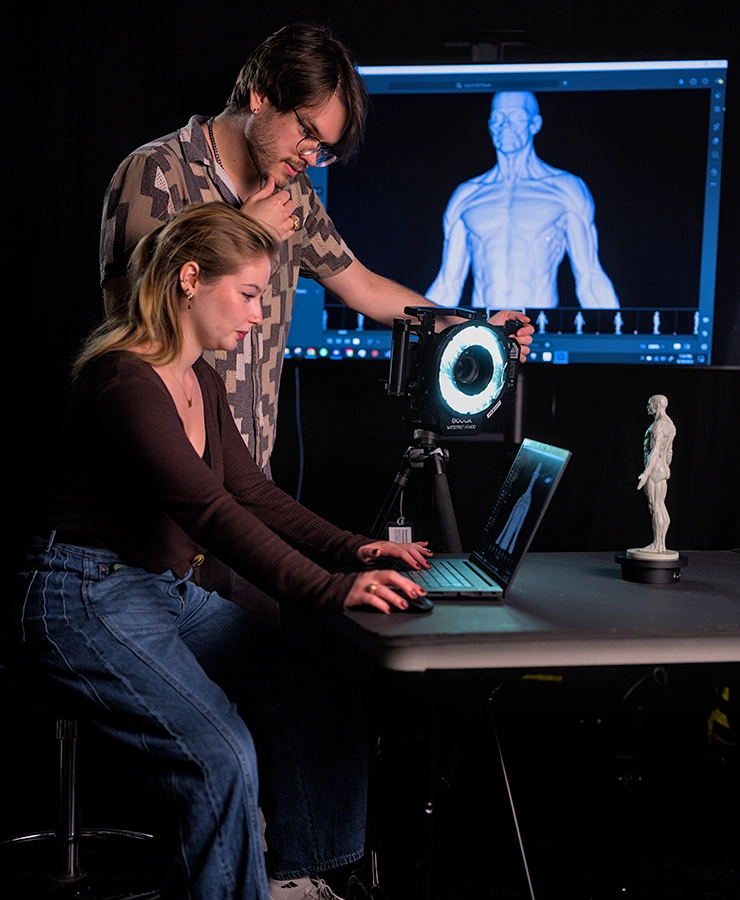 The college is building the future of the arts world by incorporating technology into its fabric and promoting collaboration across disciplines. (Photo by Justin Kling/PVFA)
At the time, the creation brought together the visualization, dance science and performance studies degrees, previously housed under the College of Architecture, the College of Education and Human Development, and the then-College of Liberal Arts, respectively. It quickly grew, and now in its fourth year, it boasts 105 faculty members, more than 660 students and five main programs: dance science, performance and visual studies, theatre, visualization and music performance. In total, the programs offer five undergraduate degrees and five graduate degrees, including a new MFA in dance and the college’s first Ph.D. in Visual Computing and Interactive Media.
Though the college is still in its infancy, it’s far from the beginning of Aggieland’s ties with the arts. Texas A&M’s earliest yearbooks reveal that students participated in music and theatre pastimes through clubs like the Glee Club and the Dramatic Club, a legacy that continues today through numerous arts-focused student organizations. The university has helped launch the start of musicians such as Lyle Lovett ’79, Robert Earl Keen ’78 and Chris Tomlin ’95. And the visualization program has gained a reputation for turning out top-notch graduates since Texas A&M first offered the subject in 1989.
Still, when it came to a dedicated academic space for the arts, Texas A&M was lacking. While the university was earning accolades and national rankings for the education it provides students in topics like engineering and business, it was playing second fiddle to other public universities in performing arts degrees.
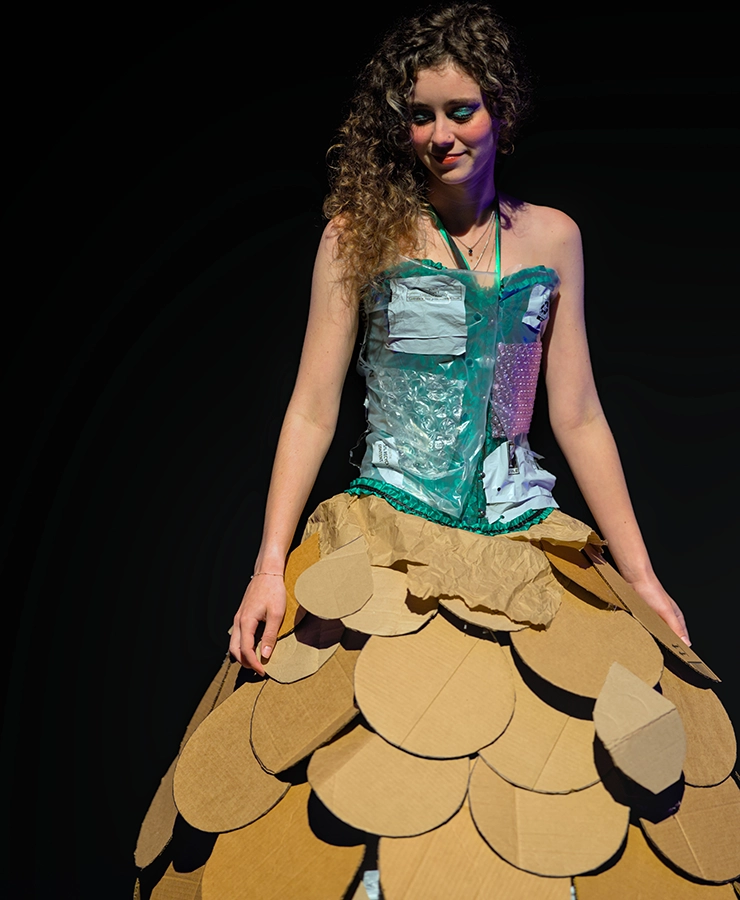 Every semester, students in the performance and visual studies’ “Dress in World Cultures” class learn by designing and sharing wearable art using recyclable materials. (Photo by Justin Kling/PVFA)
“A university can’t be the best unless it’s comprehensive,” said Tim McLaughlin ’90 ’94, dean and holder of the Ray Rothrock ’77 Endowed Dean’s Chair. “After Texas A&M had developed units like the law school and the Health Science Center, formal arts programs were the major missing piece.”
With the college’s creation, that piece was put into place as the visual arts, performing arts and technology were brought together, signaling to the world that Texas A&M was bringing a new act to the arts stage.
An Aggie Spin
Last November, I was lucky enough to catch a dance performance from students in a group choreography class, showcasing works they had developed. In one piece, dancers rolled, slid and waved their arms like pendulums in time with a deep, methodical beat, while another featured students swaying and striking poses to a mournfully eerie tune. In a third, accompanied by hopeful music, the performers gracefully spun, leaped and bent their bodies in beautiful synchronicity.
To viewers, it was an impressive display of artistic ability. But to the performers, it had the added significance of being built on a curriculum centered on the dancers’ physical well-being, something that sets PVFA apart in the world of dance programs.
In fact, every PVFA program has a unique twist on a traditional arts degree to ensure Texas A&M’s arts college offers something you can’t find anywhere else. “Other schools have great programs in the traditional forms of visual and performing arts,” McLaughlin explained. “We wanted to build programs that move the arts forward to meet the state’s needs and create where the arts are going in the next decade.”
We wanted to build programs that move the arts forward to meet the state’s needs and create where the arts are going in the next decade.
For instance, in contrast to a typical theatre degree where students hone their skills by putting on published productions from playwrights, Texas A&M’s theatre degree focuses on devised theatre, a process that allows students to create new productions from the ground up. This approach provides Aggies with experience creating original works, an increasing focus for the theatre world.
The visualization degree, unlike other universities’ visual arts programs, intertwines art, computing and science. It’s a model that’s long earned Texas A&M its spot as the top animation school in Texas and high marks in visual effects and game design, but under PVFA, the program has continued to expand to prepare students for the ever-evolving and widening range of visual careers.
Through the performance and visual studies program, students analyze the role, meaning, and social and cultural contexts of the arts. Unlike programs at other universities, which often foster this discovery specifically for visual-focused art forms like paintings or film, PVFA’s program takes a broader look by also analyzing performances and even the ways people “perform” their sense of self in their daily interactions. Students graduate with a rich cultural understanding and the ability to think critically, making them attractive job candidates in arts careers and beyond.
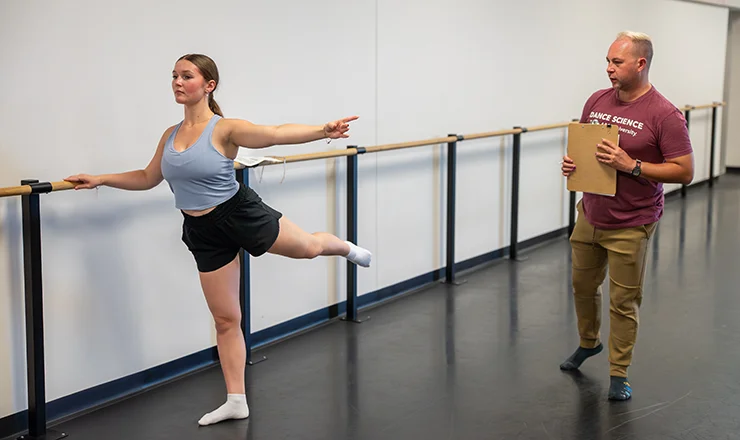 The dance science program blends a traditional degree’s focus on the aesthetics of the craft with the physiology needed to help performers safely meet physical demands. (Photo by Justin Kling/PVFA)
For aspiring musicians, many universities offer a traditional conservatory model focused on perfecting the craft of a single instrument. Texas A&M built its music performance degree with more flexibility, allowing students to explore and combine various aspects of music, including emerging areas of the field like music technology and music entrepreneurship.
And dance science uniquely blends a traditional dance degree’s focus on the aesthetics of the craft with the physiology and anatomy needed to help performers safely meet the form’s physical demands. This combination opens the door for graduates’ careers, allowing them to not only become professional dancers or dance instructors but to also obtain roles as physical or occupational therapists who incorporate the therapeutic use of dance, a practice that’s increasingly in demand.
Arts in Action
There’s always something going on at PVFA. Here are just a few examples of the student and faculty creativity that’s on display all year.
January-April
 Throughout the semester, music students perform on campus and around the Bryan-College Station community. (Photo by Justin Kling/PVFA)
Aggieland Music in the City
Over the course of the spring 2025 semester, music performance students presented a series of shows around the community, including at the Benjamin Knox Art Gallery and Casa do Brasil, to bring a bit of music to the Brazos Valley.
LASER Talk Series
Every semester, the college’s Institute for Applied Creativity hosts monthly talks from interdisciplinary speakers across arts, sciences, humanities and technology. As a local chapter of the international Leonardo/ISAST LASER network, the series aims to encourage interdisciplinary dialogue and strengthen connections with the local community.
February
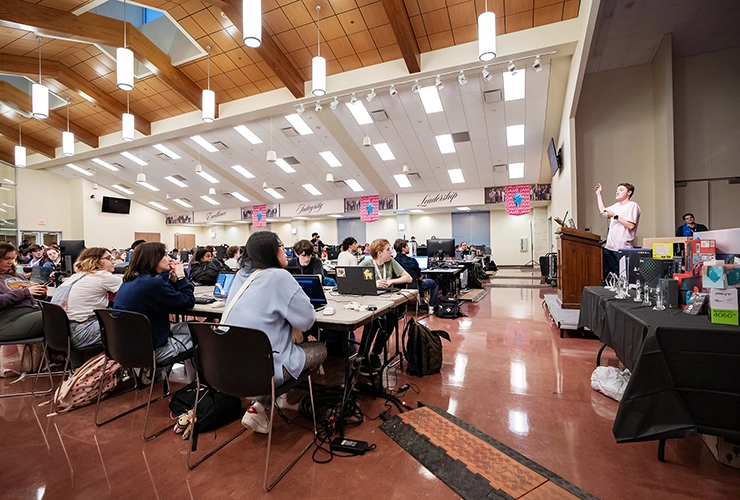 Chillennium draws students from across the nation to compete in creating video games in just 48 hours. (Photo by Laura McKenzie/Texas A&M Marketing & Communications)
Perpetual Motion
An annual event from the dance science program, this showcase presents an evening of dance, with choreography crafted by faculty and performed by undergraduate and graduate students.
Chillennium
Hosted by the visualization program, this annual event is known as the world’s largest student-run game jam and draws students from across the nation to compete in creating video games in just 48 hours.
March
“Echoes of Justice”
The theatre program’s first student-led devised production, this play examined how marginalized voices are censored and explored the power of performance through the story of a 1920s acting troupe on trial. The concept was proposed by its director, Christian Pierce Kahl ’26, and was created entirely by students over two semesters.
April/May
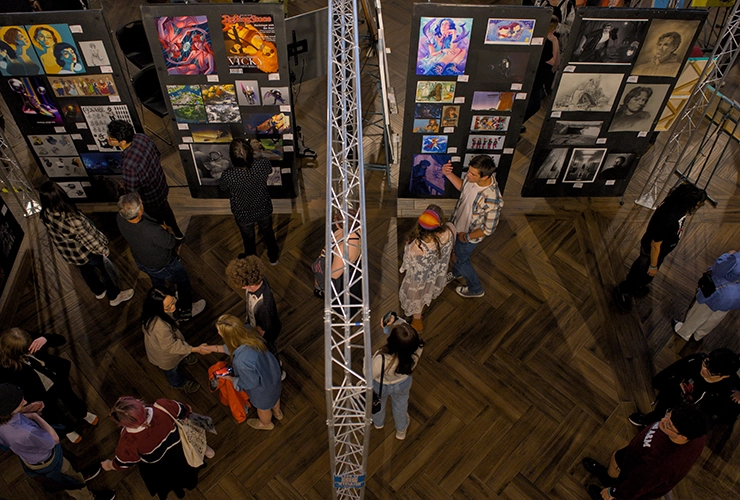 Viz-A-GoGo is the visualization program’s annual showcase celebrating student works. (Photo by Justin Kling/PVFA)
Capstone Presentations
Every April, students in the performance and visual studies program and the music performance program present their capstone projects. With works ranging from short films and music performances to art analyses, the event exhibits the variety of creativity explored by these programs.
Crescendo: Music Program Showcase
In the second week of April, students registered in music and music technology courses present solo, ensemble and InterArts performances from a wide variety of genres including classical, jazz, rock, experimental, improvised, computer programmed and original works.
Viz-A-GoGo
Held at the end of each spring semester, the visualization program’s annual showcase celebrates students’ work from the past year, including a gallery of physical works and a showing of film-based creations.
July
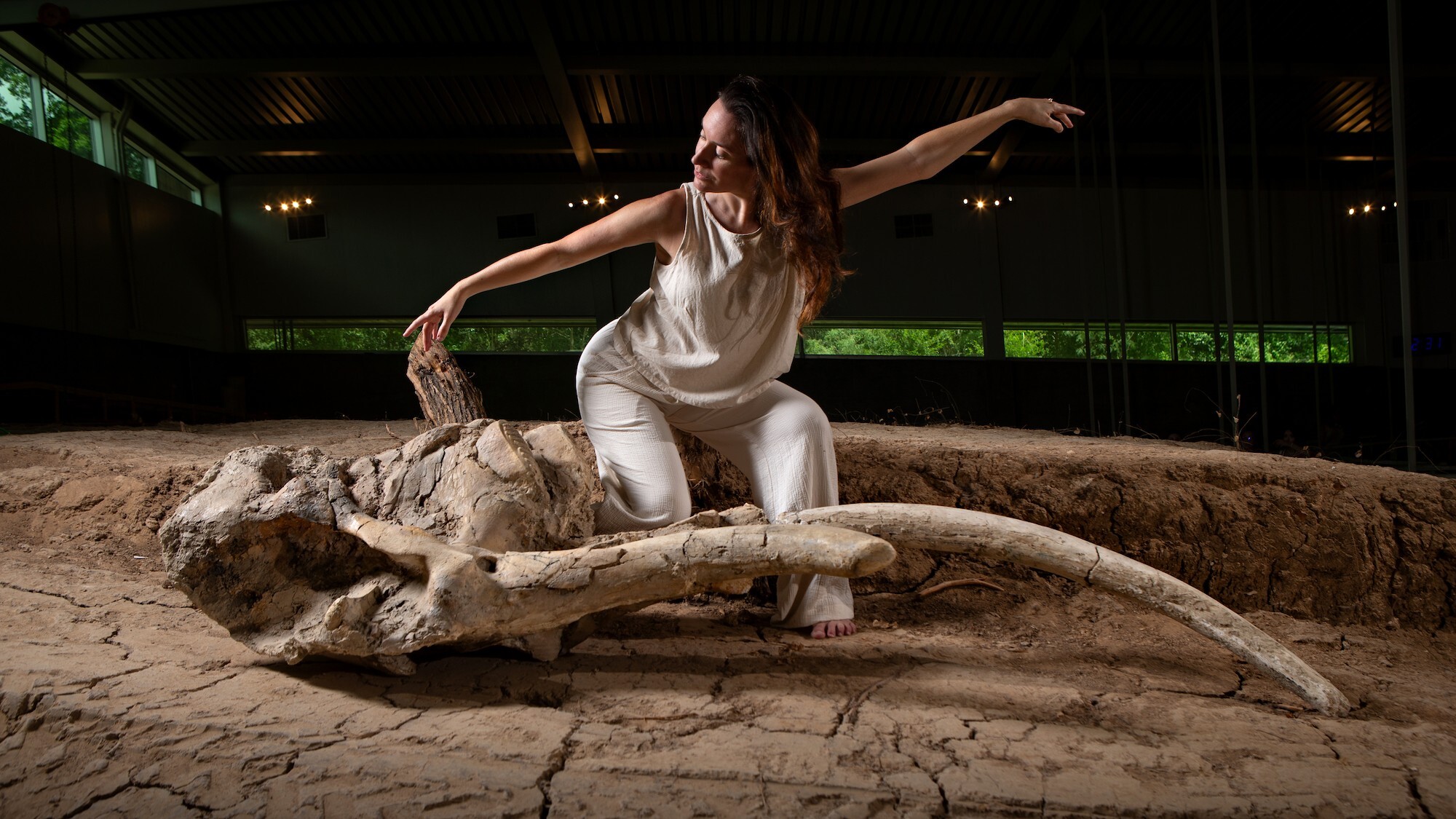 Dance science assistant professor Merli Guerra is collaborating with the Waco Mammoth National Monument on a unique project. (Photo by Igor Kraguljac '08/PVFA)
Fossilizing the Ephemeral
A collaboration between dance science assistant professor Merli Guerra and the Waco Mammoth National Monument, this project, which will grow and expand over four years, brings mammoth-inspired dance to the monument site and uses motion capture and 3D printing to capture and preserve these movements in sculpture form.
September
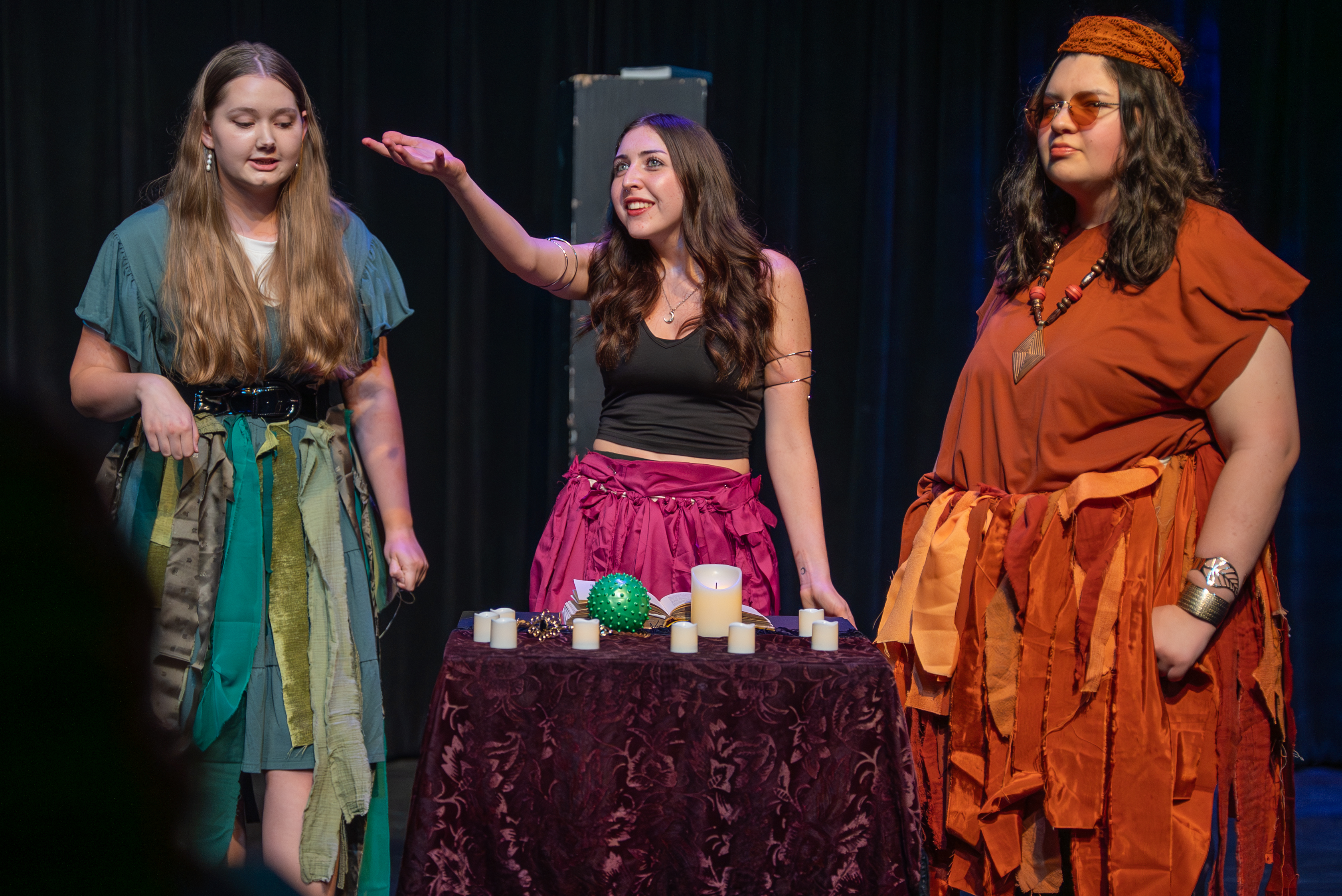 The 24-Hour Theatre Festival celebrated the devised theatre approach, in which students wrote, designed and performed new short plays in 24 hours. (Photo by Justin Kling/PVFA)
The 24-Hour Theatre Festival
The theatre program invited students of all majors to participate in its inaugural festival, where, over 24 hours, they wrote, designed and performed new short plays through the method of devised theatre.
Brazos Contemporary Dance Festival
Hosted by the dance science program and established by faculty, this annual festival gathers companies and choreographers from around the state to bring contemporary dance to the Brazos Valley.
October
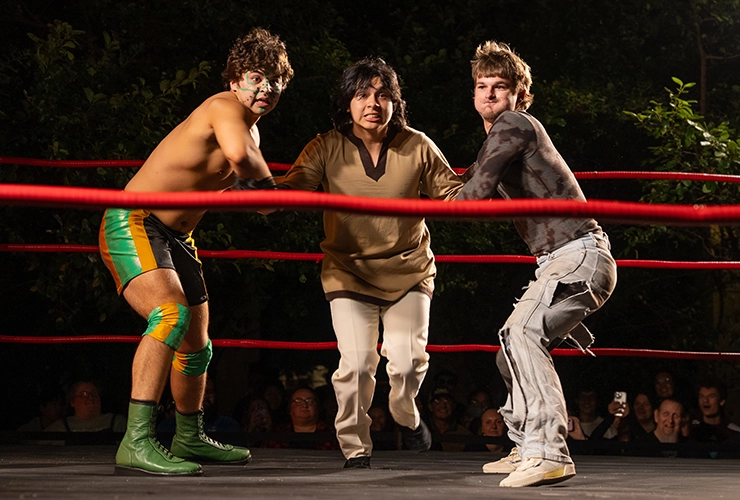 Lorefest is an annual festival exploring local and Texas folklore through performance. (Photo by Justin Kling/PVFA)
Lorefest
For five days around Halloween, this annual festival explores local and Texas folklore through music, drama and visual performances. Established by performance and visual studies professors and now a student-driven event, the festival draws collaborators from across the college, the College of Arts and Sciences, and local community members.
November
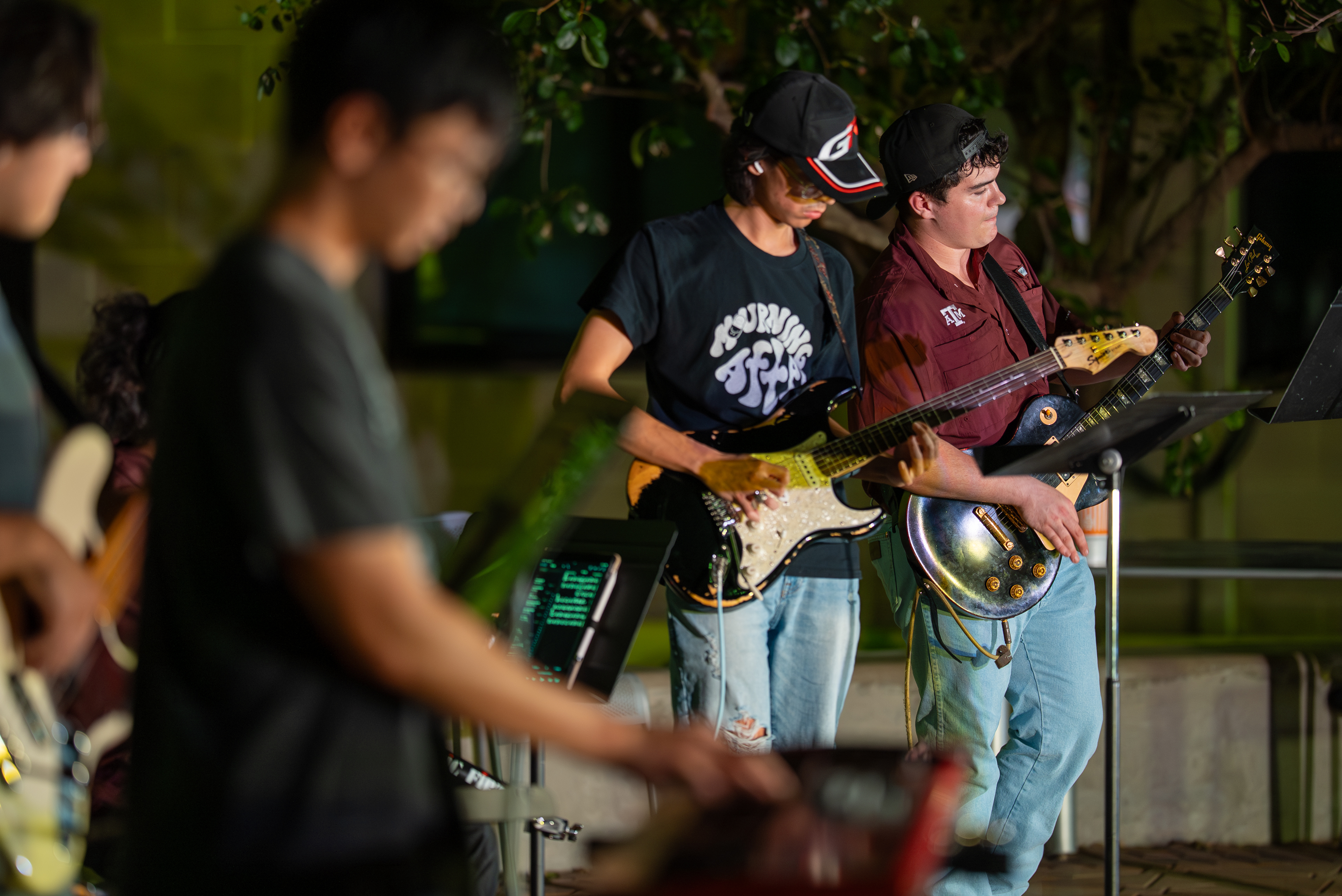 The Crescendo music showcase saw many student performances. (Photo by Justin Kling/PVFA)
Crescendo
In the music performance program’s inaugural weeklong showcase, students performed pieces for piano, woodwinds, percussion, brass, vocals, steel pan and more around campus in 14 different performances showing the program’s full range.
December
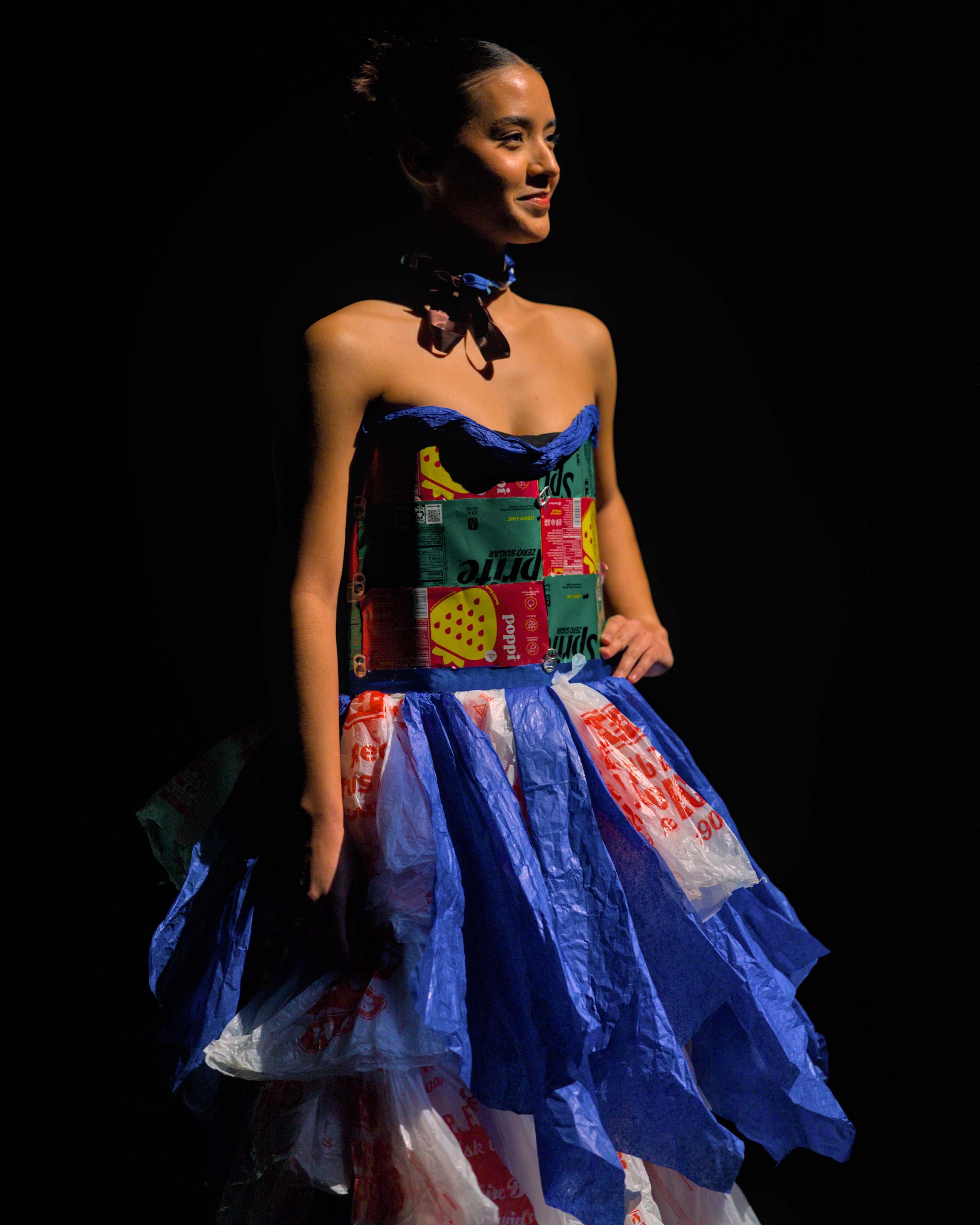 The Waste Wearable Arts Runway Show features student fashion created from recyclable materials. (Photo by Justin Kling/PVFA)
Waste Wearable Arts Runway Show
Held at the end of each semester as a culmination of the performance and visual studies’ “Dress in World Cultures” class, students learn through action by designing and sharing wearable art using recyclable materials like fabric remnants, woven bags, plastic and paper.
Performing Better Together
Last fall, the performance and visual studies program hosted a performance by Kole Odutola, a lecturer and storyteller who’s spoken around the world. Dressed in colorful Nigerian Yoruba attire, Odutola brought an electric charisma to the stage as he demonstrated the Nigerian oral storytelling tradition, weaving an engaging story of a troublemaker tortoise who tricks an elephant king. At the story’s close, he invited the crowd to discuss with their fellow attendees what might have happened next for the characters, telling the audience that when stories combine, something new emerges.
That sentiment about the exciting possibilities of collaboration is one woven into PVFA’s very fabric. Its programs collaborate on countless projects, classes and events to explore what combined art forms can create and to give students experience working with people from a wide variety of disciplines. Even the college’s structure is interdisciplinary: PVFA has no separate departments. Rather, each program area lives under the college’s overall umbrella, avoiding the across-discipline friction that can come with a departmental setup.
![]() The college’s programs collaborate on countless projects to explore what combined art forms can create and to give students experience working across disciplines. (Photo by Justin Kling/PVFA)
The college’s programs collaborate on countless projects to explore what combined art forms can create and to give students experience working across disciplines. (Photo by Justin Kling/PVFA)
![]() In the Virtual Production Institute, students and professionals can create immersive environments for entertainment projects, training simulations and more. (Photo by Justin Kling/PVFA)
In the Virtual Production Institute, students and professionals can create immersive environments for entertainment projects, training simulations and more. (Photo by Justin Kling/PVFA)
![]() Hosted by the dance science program, the Brazos Contemporary Dance Festival gathers Texas companies and choreographers to bring performances to the Brazos Valley. (Photo by Justin Kling/PVFA)
Hosted by the dance science program, the Brazos Contemporary Dance Festival gathers Texas companies and choreographers to bring performances to the Brazos Valley. (Photo by Justin Kling/PVFA)
![]() Through the Hagler Institute for Advanced Study, Lyle Lovett ’79 is sharing his music and acting expertise with students as a 2025-26 visiting Hagler Fellow. (Photo by Igor Kraguljac ’08/PVFA)
Through the Hagler Institute for Advanced Study, Lyle Lovett ’79 is sharing his music and acting expertise with students as a 2025-26 visiting Hagler Fellow. (Photo by Igor Kraguljac ’08/PVFA)
“You have musicians working with critical theorists, and computer programmers working with art historians who are working with theatre directors,” said Dr. Daniel Humphrey, the performance and visual studies academic undergraduate director. “In the 20th century, a lot of scholars believed you had to stay in your rigid discipline. But that started breaking down when people realized disciplinarity was just creating artificial barriers.”
These collaborations take countless forms throughout the college — such as dance faculty performing works in front of virtual scenes designed by visualization experts or music students composing songs and creating soundtracks for theatre productions — but also expand to other areas of the university like engineering, English and psychology. Health has been a particularly promising area of collaboration, and the college plans to soon launch an arts in health minor to expand upon its multiple partnerships with the Health Science Center and its existing work bringing art to local hospitals.
“People are seeing how the arts are foundational to many careers,” said Christine Bergeron, the dance science academic undergraduate program director. “The artist is an interdisciplinary creature, so teaching students these collaborative skills is essential for who they are.”
Expanding Their Repertoire
This intersection of the arts was also on display in the theatre program’s November 2025 production “The Post-America Variety Show,” which told the story of citizens of a post-apocalyptic New College Station putting on a secret variety show.
As the audience shuffled into the theater, a student at a piano onstage took requests, underscoring the pre-show with whatever songs the audience called out. Onstage, the set designed by a theatre student included brick walls, towering arches and platforms strung with colorful empty milk jugs. Above it all stretched digital projections depicting patches of starry night sky to enhance the immersion of the play.
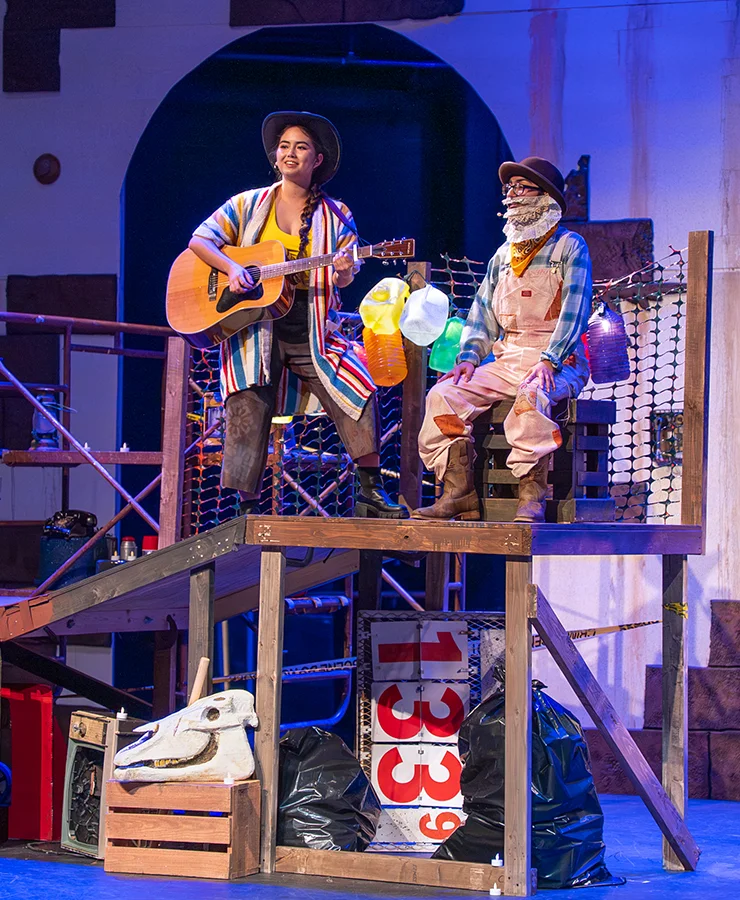 An emphasis on devised theatre allows students to create shows from the ground up, creating everything from the script to stage backdrops. (Photo by Justin Kling/PVFA)
The projections were the handiwork of visualization major Diego Gonzales ’26. Though he entered Texas A&M hoping to focus on film animation, those plans changed his junior year when he joined the Aggie Theatre Company student organization and began using his visualization knowledge to design projections for the stage.
“I’ve really utilized my time in theatre to advance my visualization skills,” Gonzales said. “I didn't expect to do anything related to theatre in college, but it’s 180-ed my college career by shifting my focus toward using visualization for live events and interactive media.”
As one of the college’s newer programs, launched fall 2024, collaboration has been essential for the theatre program’s productions thus far. “With devised theatre, everyone has something to contribute,” said Rayna Middleton Dexter, the theatre academic program director. “Many of our students have friends in visualization and music, and they also want to get in on our shows.”
You’ll find the same thing happening all throughout the college as PVFA students devote long hours in visualization studios, music rooms and black box theaters, developing skills for their future careers while creating the art they love together.
“It’s so rewarding to take the ideas we’ve worked on in class and put them into practice onstage,” said Christian Pierce Kahl ’26, a theatre major who designed the set for “Post-America” and directed the program’s first student-led piece this spring. “When I’m working on a show, it feels like my brain’s exploding every day thinking of how the things I’m designing will interact with what people from other disciplines are doing for the production. I try to absorb everything that’s happening and let it inspire me.”
Visualizing the Workforce
Last fall, I stopped by the Langford Architecture Building to check out the visualization program’s “What If” Day, dedicated to showcasing opportunities for collaboration. Langford C’s fourth floor was packed with demonstrations, but though the program is best known for film animation, the projects on display had potential well beyond the entertainment industry.
With artificial intelligence and emerging technologies reshaping creative fields at an unprecedented pace, we want our visualization students to be the ones driving innovation, pushing boundaries, and shaping the future of visual art and interactive media.
One team had used motion capture to track movements and facial expressions for forensic nursing training simulations. Another created virtual reality video games to help improve patients’ eye muscles and hand-eye coordination. And one faculty member was exploring how training robots through virtual simulations can lead to advances in manufacturing.
“Our goal is not just to teach technical skills but to help students think critically, adapt and take the lead in an industry that is constantly evolving,” said Hadeel Ramadan, the visualization academic undergraduate program director. “With artificial intelligence and emerging technologies reshaping creative fields at an unprecedented pace, we want our visualization students to be the ones driving innovation, pushing boundaries, and shaping the future of visual art and interactive media.”
Preparing students for the workforce is another key reason for the college’s interdisciplinary focus. “The state has a large workforce in the arts, and as a land-grant institution, Texas A&M has a responsibility to prepare the future workforce,” McLaughlin explained. “And the greatest need is for people who can speak multiple disciplinary languages. We’re producing those kinds of students.”
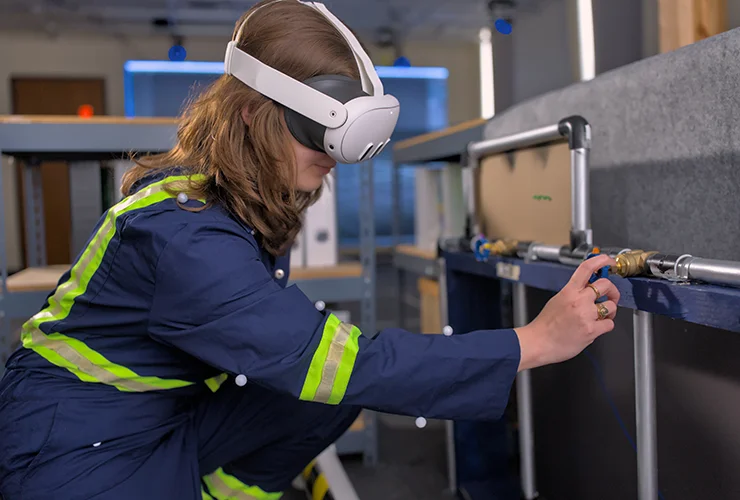 The college is leveling up students’ marketability in the workforce by giving them hands-on experience with emerging technologies. (Photo by Justin Kling/PVFA)
Though the music performance and theatre programs are just beginning to award degrees, the other three programs have seen their students gain jobs at gaming companies; film studios like Pixar, Disney and DreamWorks; corporations like Apple and Google; universities; museums; occupational therapy practices; and even their own arts-related businesses.
One of those successful graduates is Gracie Arenas Strittmatter ’04 ’08. Even before earning her master’s in visualization, Strittmatter had already landed a job at Electronic Arts (EA), where she’s worked for the last 17 years. She’s contributed to games like Madden NFL and Star Wars: The Old Republic and now oversees a team of software engineers and technical artists as a supervising director of technical operations for EA Sports.
“Texas A&M builds superheroes, and I think that’s driven by the Aggie core values,” Strittmatter said. “They’re what gave me the confidence to step into leadership roles years before I realized I was ready.”
Strittmatter and her husband, Willem ’02 ’05 ’19, are paying these opportunities forward through two endowed scholarships: one for visualization students studying game development and one for underrepresented female students in the program. They also contribute to an annual scholarship with other Aggies who work at EA that benefits students at the program’s annual Viz-A-GoGo showcase.
“Visualization didn’t have any scholarships from former students, so we thought, ‘If we’re going to make an impact, let’s make it in a place with uncharted territory,’” Strittmatter shared. “By supporting PVFA, we’re helping students build careers that shape industries and enrich our society, and we’re just at the beginning of seeing what this college will cultivate.”
The Future Is Virtual
By now, it might be easy to guess another of the college’s key players: technology. At a scientific and engineering powerhouse like Texas A&M, each of the college’s disciplines are infused with technology as yet another way PVFA is innovating for the arts of tomorrow.
“Technology has been changing the way people learn, work and play, and we want to be ready for where our future students, businesses and the arts will be a few years from now,” McLaughlin explained.
One starring example is the college’s Virtual Production Institute (VPI), which brings the field of virtual production to Aggieland.
The technique is the next big thing in the film industry, replacing the green screen method with massive, immersive LED screens to display a digitally rendered world in real-time. Now, instead of performing in front of a blank green wall, actors can react to environments like a “Lord of the Rings” world or a busy cityscape right in front of their eyes while crews can create more realistic lighting looks. The tool exploded during COVID-19 lockdowns and is now used in up to 50% of films.
However, these entertainment applications only scratch the surface of the technology’s potential, which can benefit a wide range of disciplines like medicine, manufacturing and architecture through the ability for digital twins, training simulations and more.
Thanks to state support, the VPI has created three virtual production stages: two at Texas A&M-Fort Worth and one 52-foot curved screen in College Station, with plans to open a new, 10,000-square-foot stage on West Campus later this year.
The institute aims to provide essential workforce training to help Texas boost its role in the media and extended reality industries through a strong pipeline of virtual production professionals. The stages are used for projects for PVFA’s programs, colleges across campus and producers in the entertainment industry, as well as industries involved with aerospace, health care and emergency response.
That combination of academics and industry makes the VPI the first of its kind nationally.
“Our students are getting an experience that not many institutions provide,” said Wayne Miller, the VPI’s head of production and executive producer. “Virtual production stages are still a relatively new tool. There are people who work in the industry who don’t have any experience working on an LED stage, but our students do.”
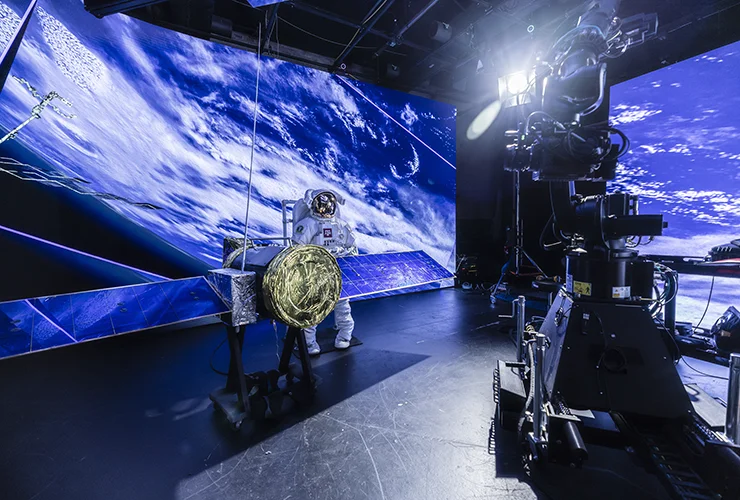 The university utilized the college’s Virtual Production Institute last year to film a scene for its “A Force for Good” trailer. (Photo by Abbey Toronjo/Texas A&M Marketing & Communications)
The institute maintains close industry relationships, including a partnership with Sony Electronics, which furnished the stages’ top-of-the-line equipment and collaborates with the college on workshops and other events.
Beyond this partnership, Sony has also invested in the college’s commitment to shaping future professionals by funding the Sony First-Generation Student Success Fund, which supports programs for the first-gen students who comprise more than 19% of the college’s population.
“Through this fund, Sony looks to mentor, develop and nurture future talent by providing them with opportunities,” said Theresa Alesso, president of Imaging Products and Solutions Americas at Sony Electronics. “We are invigorated by the way this partnership has grown organically and brings value to all involved. Staff and students are given unprecedented access to state-of-the-art technology, while Sony receives valuable feedback from the voices who are poised to shape the future of the industry.”
A Crescendo of Impact
At an InterArts Showcase from the music performance program last fall, music students played piano, vibraphone and marimba in collaboration with a visualization class that created audio-reactive visuals to pair with the music and interact with it in real time.
The last musician to perform was Grace Burton ’26. Her mallets flew over the marimba bars as she performed with astounding speed and precision. Her performance ranged from high and lively music to deep, rich and celestial notes, while the screens behind her displayed dots and orbs that zipped past or rotated gently based on the music. The combined effect of visuals and music conveyed both an exciting liveliness and a majestic beauty.
The budding music performance program is gearing up for its first two graduates to walk the stage this spring following creation of the music performance degree in fall 2024. (Photos by Justin Kling/PVFA)
But for Burton, it was a performance that almost never happened. Though the senior has a lifelong passion for music, she arrived in Aggieland without the option of a music program.
“When I toured Texas A&M, I saw the Aggie family and fell in love with the place,” she shared. “I started in performance studies and joined a few music organizations, but by the end of my first semester, I found myself wanting more with music than just the one-off performances I was doing.”
She began to consider bidding Aggieland farewell to pursue her music degree dreams, but then she received the news: PVFA was officially opening its music performance degree in fall 2024. Fast-forward to today, and Burton will be one of the program’s first two graduates this spring, leaving the university with new music skills, experience composing and performing original pieces, and a new passion to be an interdisciplinary percussionist like her faculty mentors.
“This has been a crazy, experimental experience for me,” she said. “And I’ve loved every second of it.”
Burton isn’t the only student who’s found her place in PVFA. The college allows students like her to achieve their dream of becoming both an Aggie and an arts professional, but by infusing the arts into Aggieland, it also has the potential to impact every student.
The creative arts are a benefit to non-creative enterprises, and creativity makes for better solutions in any field.
“We want students to leave Texas A&M as well-rounded individuals who represent the best of themselves and the best of this university,” said Andrea Edwards, the music performance academic program director. “But without the enrichment of the arts, we turn out people who are 75% complete. We want to create a positive impact in today’s world, and that requires 100%.”
The sentiment is shared by architects and Texas A&M Distinguished Alumni Shelley ’78 and Jeff Potter ’78. Recently, the couple’s combined passion for music and student success guided their decision to provide funding for the music performance program to purchase 10 top-of-the-line Fender guitars for students to hone their skills.
“The creative arts are a benefit to non-creative enterprises, and creativity makes for better solutions in any field,” Jeff said.
“I serve on the college’s Dean’s Development Council, and it’s been so exciting to learn about the innovation happening at the college,” Shelley added. “The potential is unlimited.”
McLaughlin agrees. “I want Texas A&M to be the place everybody looks to,” he said. “PVFA is built to make Texas A&M the leader in defining and educating for future forms of the arts. There’s an immersive experience economy on the horizon for the 2030s with the advance of technology like AI and 6G, and someone will be designing and defining what the performing and visual aspects of our augmented world will look like. Our college is designed for and positioned to be the center of that work. A few decades from now, I want people to say, ‘If you want to understand how the arts are transformed and are transforming people’s experiences, you’ve got to go see what’s going on at Texas A&M.’”

Send Message to Felicia
Thank you for submitting a contact form!
Contact form was unable to submit.