Fort Worth’s commitment to education traces back to 1854, when pioneer John Peter Smith started the area’s first school, charging $5 a month for tuition. While times (and tuition prices) have significantly changed, the community’s commitment to an educated populace remains steadfast.
By 2020, Tarrant County was home to 20 school districts, numerous private schools, a community college system and several well-regarded higher education institutions. However, it still lacked the broad offerings of a Tier 1 research university.
It’s a rare opportunity to watch something this significant come to life. We’re going to look back 10 to 20 years from now and see this period as a key inflection point in the city’s growth.
The establishment of Texas A&M-Fort Worth in 2021 changed that equation. Building on the Texas A&M University School of Law’s meteoric rise over the last decade, the campus — which will house programs from eight Texas A&M colleges and schools, six Texas A&M University System agencies and Tarleton State University — enjoys significant support from area leaders who understand its potential to catalyze transformation.
“When we presented city, county and business community leaders with the concept of a new campus that was focused on innovation and would bring together multiple academic disciplines and industry partners that needed us to meet their research and development, hiring, and workforce training needs, they jumped at the chance,” said Bobby Ahdieh, Texas A&M-Fort Worth’s chief operating officer and dean of the law school. “At Texas A&M, meanwhile, we saw an opportunity to create new engagement opportunities for every one of our students and faculty members in one of the fastest growing metropolitan areas in the country.”
Howdy and Hub-abaloo
Texas A&M’s expanding presence comes as Fort Worth’s national profile increases. The city — outpacing other major Texas cities in growth since 2020 — recently topped 1 million residents to become the nation’s 10th largest city.
The once-in-a-lifetime opportunity to create an urban campus in a rapidly growing community caught the eye of Texas A&M University System leaders. With their wholehearted support, the campus will open a Law and Education Building this fall, followed by the Research & Innovation Building, a Virtual Production Studio and additional buildings to follow.
Texas A&M-Fort Worth, which will initially focus on programs in law, health care, agriculture, engineering and entertainment, will utilize a synergistic “hub” model that brings together academic classrooms, research facilities and commercial tenants. The campus’s potential to be part of a North Texas version of Silicon Valley attracted the attention of Becky ’78 and Jim Wilkes ’78, who were the first donors to pledge their support.
Set to open this fall, the Law and Education Building will be the first of multiple buildings on Texas A&M-Fort Worth’s campus, housing programs in law, engineering and health sciences. (Photos and rendering courtesy The Texas A&M University System)
“We saw the vision for what this campus would mean economically for Fort Worth,” said Jim, president of Texland Petroleum LP. “It will create a research environment where companies work with academia to create new technologies and new opportunities for the world.”
This collaborative approach, led by the Fort Worth-Tarrant County Innovation Partnership, is projected to result in more than 25,500 permanent jobs and $3.1 billion in total economic activity over time. “It’s a rare opportunity to watch something this significant come to life,” said Greg Bird ’82, CEO and president of Jetta Operating Company Inc., who, along with his wife, Laura ’82, is also financially supporting Texas A&M-Fort Worth’s construction. “We’re going to look back 10 to 20 years from now and see this period as a key inflection point in the city’s growth.”
Alongside the law school’s fast-growing degree and certificate programs for lawyers and non-lawyers alike, three colleges are on the leading edge of the university’s expansion into Fort Worth.
A Personalized Approach
Naresh K. Vashisht College of Medicine
The Fort Worth campus’s hub model has the potential to lead to significant breakthroughs not only in Tarrant County and the surrounding area but also across the Lone Star State and the nation.
Case in point: Texas A&M’s Naresh K. Vashisht College of Medicine, which is pursuing initiatives that will spark transformational research and generate hard-to-imagine commercialization opportunities. These budding initiatives will extend the college’s Fort Worth footprint, which began in 2023 with the establishment of the Institute for Healthcare Access, a collaborative effort between the college, Texas A&M Health and the School of Law.
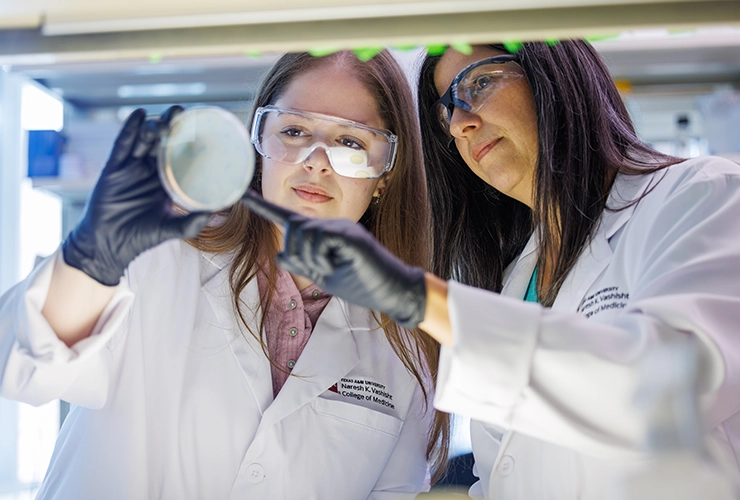 With a biorepository network in Fort Worth, the Vashisht College of Medicine seeks to represent all Texans in the data driving translational research. (Photo by Mathew Baughman/Health Science Center)
College leaders are excited about the unique possibilities emerging from its presence in Fort Worth. “All of Texas is the Vashisht College of Medicine’s campus, because under our distributed model, our students work with clinical affiliate partners across the state,” said Dean Amy Waer ’23. “But we don’t have an associated teaching hospital, so we lack access to human clinical samples and DNA that can help with basic, translational and clinical research.”
To remedy that, the college has prioritized creating a system of biorepositories, starting with Texas A&M-Fort Worth, and is developing agreements with a network of Fort Worth-area medical institutions serving adult and pediatric patients to collect human tissue samples with patient approval.
Biorepositories have traditionally supported cancer research, but Vashisht College of Medicine leaders see a treasure trove of research possibilities. “We want to add value to the biorepository concept so that it can be used to study chronic human diseases like obesity, diabetes and cardiovascular disease,” said Dr. Thomas Cunningham, senior associate dean of research. “We also want to use the repository to help the partnering hospital meet its needs, so that the collaboration is mutually beneficial.”
Eventually, the college plans to create a wider network of biorepositories across the state with the goal of improving every Texan’s health, including those in rural areas. “People living in rural settings aren’t well represented in the data sets used for personalized or precision-treatment protocols,” Cunningham added. “Creating a system that better represents rural Texans is vital in identifying better health care outcomes and eventually improving their care through a personalized approach.”
Engineering a Takeoff
College of Engineering
The College of Engineering is taking a similarly personalized approach in Fort Worth as it builds on its previous research, workforce development and academic work in the region. College leaders conducted a market analysis during early campus planning to better understand regional industry needs and avoid duplicating other higher education institutions’ work.
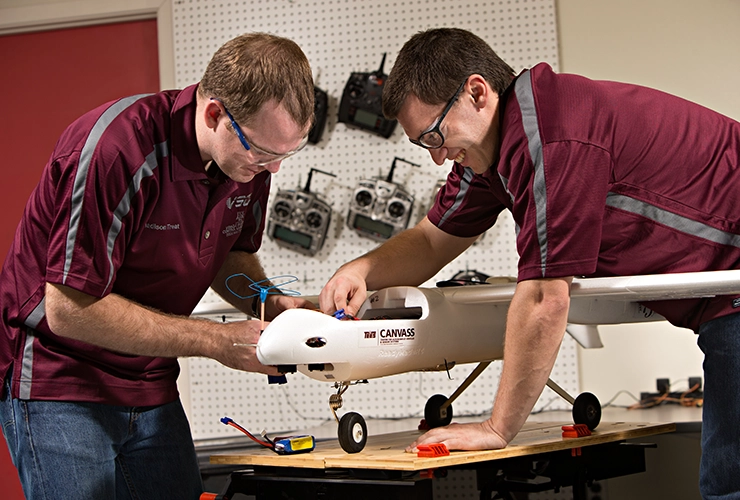 From multiple collaboration opportunities to building on existing programs, Texas A&M-Fort Worth presents new possibilities for the College of Engineering. (Photo courtesy College of Engineering)
As a result, the College of Engineering is collaborating with the Fort Worth-Tarrant County Innovation Partnership to create an Aerospace and Aviation Innovation Hub. This initiative will allow the college to leverage its expertise in aerospace, electrical, computer science, mechanical and industrial engineering to support industry in the Aviation and Defense Capital of Texas.
“All the companies we talked to said: ‘We need help on very applied research that will make a difference for the company’s bottom line,’” said Associate Dean for Research Dr. Ivett Leyva.
The college will also expand its commitment to North Texas’ workforce development, building on the Texas A&M Engineering Experiment Station’s long-standing and well-regarded professional and continuing education offerings in the region. A key component will be deploying new undergraduate degree programs at Texas A&M-Fort Worth. The first will be a bachelor’s in industrial distribution in fall 2026, with a bachelor’s in manufacturing and mechanical engineering technology anticipated in fall 2027. Both programs are pending approval from the Texas Higher Education Coordinating Board.
We want to connect academia, industry and the community for the good of our students but also for the good of the community, the nation and the world.
These undergraduate programs will also strengthen the Texas A&M Engineering Academy at Tarrant County College. Students in the academy — part of the university’s and nation’s first engineering transition program — take Texas A&M engineering courses taught by Texas A&M faculty while also taking foundational coursework at the community college. “Our vision is that the Tarrant County College program can be an excellent feeder into the engineering programs at Texas A&M-Fort Worth for students who want to stay in the area,” said Dr. Cindy Lawley, assistant vice chancellor for academic and outreach programs.
Additionally, the college plans to offer hybrid professional master’s degree programs in 2027, with the hub approach allowing faculty to work with company representatives to tailor graduate students’ education to specific industry needs.
The College of Engineering is also committed to creating an ecosystem that invites Aggie engineers to engage with Texas A&M-Fort Worth as professors of practice, mentors or guest speakers. “We want to connect academia, industry and the community for the good of our students but also for the good of the community, the nation and the world,” Lawley added.
Enter Stage Left
College of Performance, Visualization and Fine Arts
The College of Performance, Visualization and Fine Arts is bringing some of the latest high-tech production wizardry — including the cutting-edge technology used in making the popular series “The Mandalorian” — and a commitment to exceptional storytelling to Texas A&M-Fort Worth.
The college already has a Fort Worth outpost, occupying one floor of a historic building near the future campus. Embracing the hub model, the college and its Virtual Production Institute share the location with the gaming company ProbablyMonsters Inc. and finds students already benefiting from being literally steps away from industry — through internships, guest lectures, mentorships and regular interaction. “Our students get firsthand exposure to an actual industry professional environment,” said David Parrish ’90 ’95, the college’s director at Texas A&M-Fort Worth.
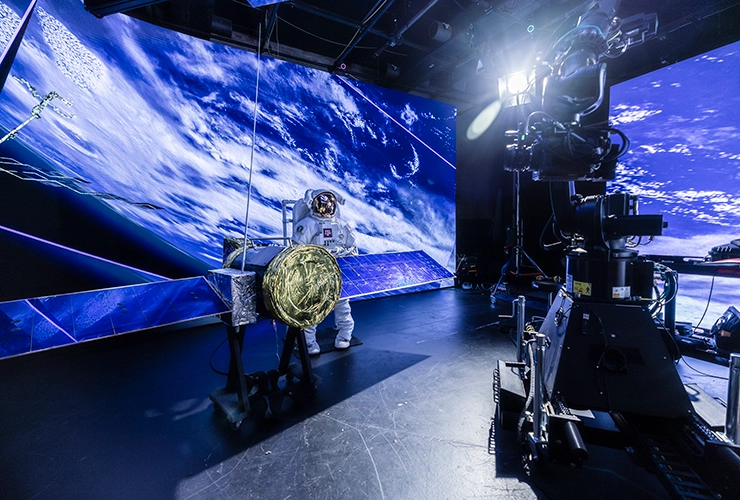 Texas A&M's "A Force for Good" trailer features a scene filmed on one of Fort Worth's virtual production stages. (Photo by Abbey Toronjo/Texas A&M Marketing & Communications)
The college is using the Fort Worth location as an option for students to fulfill their study-away requirement and capitalize on the city’s vibrant arts and technology environment. For example, students can work with area industry to create an immersive 3D environment for employee training, tap into the area’s storied fine arts community, or work at the massive new film and television production campus being built in Fort Worth by “Yellowstone” creator Taylor Sheridan.
The college already has access to cutting-edge facilities in Fort Worth, including two virtual production stages with the latest technology. “Few places in the country can offer students this level of immersive, hands-on training with these types of virtual production systems,” Parrish said. “What we’re providing offers a significant advantage for workforce development, giving our students unparalleled access and experience with these advanced tools and technology.”
Additional opportunities will be available after construction of Texas A&M-Fort Worth’s Virtual Production Studio. The planned 28,000-square-foot facility will house a full-size virtual production stage, a performance space, a digital studio and classrooms, making it a destination for art lovers or industry partners who want to tap into the college’s talent or spaces.
Now two years into being part of the fabric of Fort Worth, the college’s faculty, staff and students are excited about the growing opportunities. “It’s been a wonderful experience to engage with the people of Fort Worth,” said Dean Tim McLaughlin ’90 ’94. “They’re interested in what we’re doing and bring a positive mindset. There’s excitement across the board, from talking about the future of the arts and technology to student opportunities. Whether we’re interacting with individuals, companies or civic leaders, it feels like a great fit.”

Send Message to Jerri
Thank you for submitting a contact form!
Contact form was unable to submit.