1967 Champs
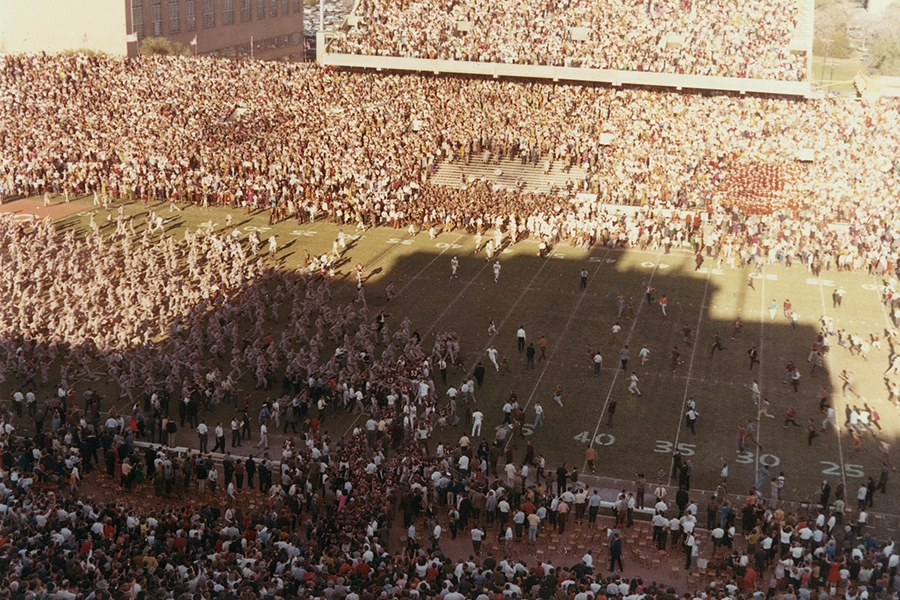 Photo courtesy Cushing Memorial Library and Archives
I’d like to relive Thursday, Nov. 23, 1967. On that cool, crisp Thanksgiving Day in Kyle Field, the Texas Aggie football team defeated the tea-sips 10-7. It was a tough, gritty game that was highlighted by an 80-yard touchdown pass from Edd Hargett ’69 to Bob Long ’69 and some last-minute defensive heroics. The Aggies had turned around a 0-4 season start and won six games in a row, achieving their first winning season since 1957. Texas A&M was the Southwest Conference football champion for the first time in 10 years, and we were going to the Cotton Bowl!
After the game, the crowd spilled out onto the field. The fish chased down the Yell Leaders and carried them off to the Fish Pond. We stood in the stands and savored it all. The band formed up on the field, we joined them and then everyone marched off to “The Aggie War Hymn.” It was all so perfect and so exciting.
As I left Kyle Field with my date, I reflected on what I had witnessed. We had beaten t.u. for the first time since 1956 and had won the Southwest Conference championship. What was strange was that I had actually expected Texas A&M to win the game. The 10-7 outcome somehow seemed normal in an abnormal year.
To put icing on the cake, a little over a month later, Texas A&M knocked off Alabama 20-16 in a damp, cold Cotton Bowl Classic game on New Year’s Day 1968. The Aggies would not win another Cotton Bowl Classic until 1986.
Lt. Col. Michael “Mike” P. Hoffman ’68
Windcrest, Texas
A Proud Father
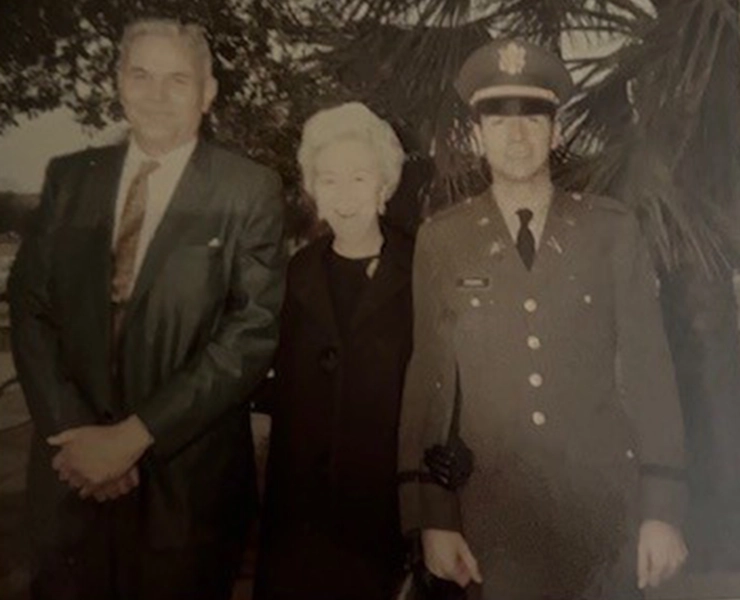 Lt. Col. John French '68 on his graduation day with his parents.
My most memorable day was Jan. 19, 1969: my graduation day and the day I received my commission in the U.S. Army. My wonderful mother and father attended both ceremonies.
My father, John P. French, had served as a combat infantryman with the 36th Division of Texas from 1942 until mid-1945. He was a staff sergeant and, as a veteran of many battles, held contempt for most — if not all — junior officers.
Well, the first person I confronted after my commissioning was my 6-foot-5-inch, 250-pound father. He didn’t smile, but he stood at rigid attention, saluted and said, “I’m proud of you, lieutenant.”
Lt. Col. John French ’68 (Ret.)
Boerne, Texas
Bugle Rank
There are so many cherished memories, but one is indelibly printed in my brain. I vividly remember being on the Bugle Rank of the Aggie Band and stepping off on Kyle Field for the very first time as a senior. Standing in front of the band and 80,0000 screaming fans produced a feeling in me that has never diminished over time.
Dan Fischer ’71
Gause, Texas
Electric Stands, Maroon Fans
Oct. 10, 1998, was the day of the first Maroon Out game at Kyle Field. Our Aggies hosted the defending national champions, the Nebraska Cornhuskers! My friend and class president Kyle Valentine ’00 came up with the idea for Maroon Out, and that stadium was electric. I was there with my roommates and best friends, and I had never heard Kyle Field that loud. The 12th Man was ready to support, and the thought was that if we could all wear maroon (much like Nebraska does with their red), then it would inspire the team to pull out a win — and it worked! The Aggies won 28-21. That was the best day, and the party at Northgate after was one for the books!
Gordon Rhodes ’00
Fort Worth, Texas
Enemies to Friends
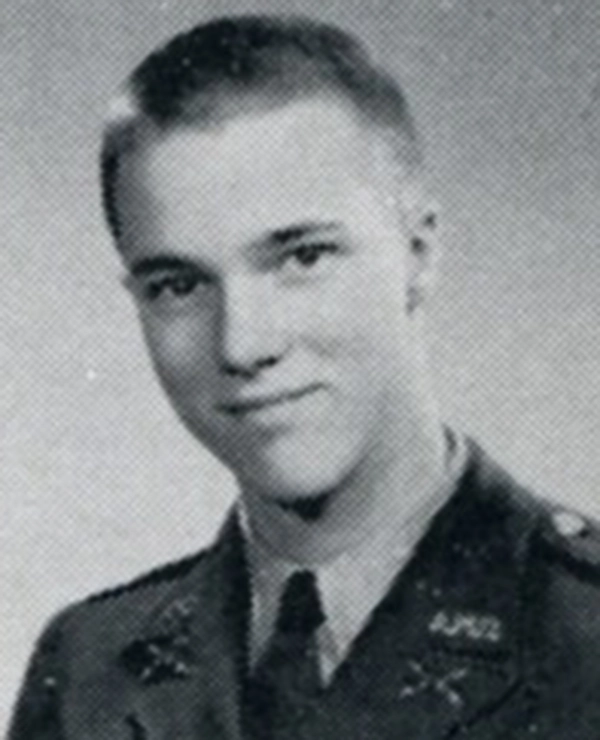
In fall 1955, our “C” Field Artillery Battery contained the most brutal collection of Pissheads (sophomores) in the Corps of Cadets that year, and perhaps any year of the 20th century. I cannot count the hours we fish spent confined in the showers, steamed like a sauna, braced in “square chairs” against the walls, holding our rifles fully extended and wearing ponchos and helmet liners.
For Fish Day 1956, our roles were reversed, and we wreaked revenge. Besides the fully dressed shower-turned-sauna square chairs we forced on them, our most delightful insult was replacing all the sophomores’ Texas A&M ROTC uniform patches with orange and white patches from The University of Texas ROTC, including Bevo horns.
It was a great surprise to me that in fall 1956, after returning to campus, we discovered that these Pissheads, now Serge Butts (juniors), were not so evil after all. We made friends with many of them, and they seemed to forget what a tremendous insult was laid on them that Fish Day.
Ted Goldenberg ’59
Bristow, Virginia
First Muster
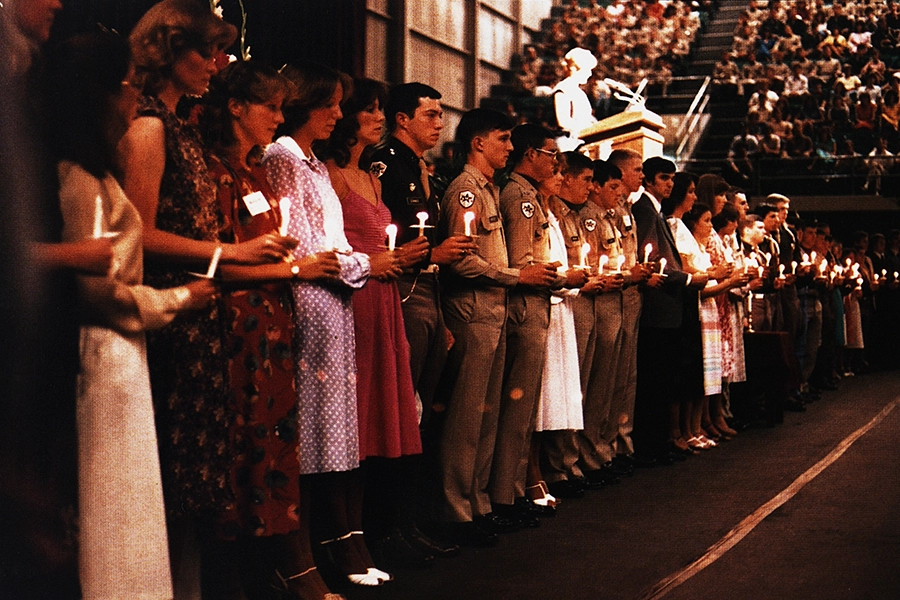 Photo courtesy Cushing Memorial Library and Archives
On April 21, 1981, I walked to G. Rollie White Coliseum to attend an event I’d heard about called Muster. The speaker was Fred McClure ’76, and I heard a speech and was part of a ceremony I’d remember for the rest of my life. The building was packed, but it was so quiet you could hear a pin drop. As the roll was read and voices called “Here,” I knew this kid who grew up in Austin had made the right decision when choosing what college to attend.
Mike Sisson ’83
Arlington, Texas
Gubernatorial Inauguration
I was a member of the RV Company in 1956-57 and 1957-58. The spring semester of 1957 saw a gubernatorial inauguration. As the Honor Guard for the governor, we flanked the reviewing stand on South Congress. A very cold wind was blowing around the capitol building and down the street. In spite of trying to dress adequately that morning, I still wondered if my feet were going to come together every time we came to attention for the numerous American flags present in the parade.
I remained in Austin during the day because we had tickets for the inaugural ball that night.
A girl that I had grown up with in church and attended and graduated from high school with in Tyler, and who was also the best friend of my fiancé, was a student at the university. She had invited me to have supper with her in her dormitory on campus. I remained in my RV white uniform and met her at the appointed time. Dinner went well. But suddenly the entire dining room got VERY quiet. I looked around and saw a waiter with a large serving tray held high coming toward me. In the center of the tray was a single cup of hot tea which was set before me very ceremoniously. Using as much etiquette as I could muster, I downed the cup amidst a thunderous round of laughing from the other diners.
Maj. Charlie “Woody” Rice ’58 (Ret.)
Tyler, Texas
Leading the Band
.jpg) Photo courtesy Cushing Memorial Library and Archives
Photo courtesy Cushing Memorial Library and Archives
I’d relive the first football game during my senior year of 1972, when I was the Aggie Band’s Head Drum Major. Stepping out, making a counter turn to face the band and going into the step-off routine was a bit intimidating that first time. The last two drills, standing on the field beating time with my baton while the band did a perpendicular march-through, was an exercise in total faith. I trusted in all 288 bandsmen being where they should be at just the right time and moving in just the right direction, all while playing their instruments. What could EVER match that?!
Alan Gurevich ’73
Seattle, Washington
Model in Aggieland
 A November 1977 issue of The Battalion reported that Playboy model Ashley Cox dined with cadets at Duncan Dining Hall during her promotional tour.
When I was a junior, the Aggieland Inn in College Station was purchased by the Playboy Corp. Months after a big remodel, the inn held a grand reopening. The Battalion said that Ashley Cox, the model featured as the December 1977 Playboy centerfold, was going to cut the ribbon. My buddy Larry and I went to work on a plan. We dialed up the Aggieland Inn, and Larry asked to be connected to Ashley’s room. The receptionist obliged, and Larry’s eyes grew big as half-dollars.
We introduced ourselves as the official Texas A&M University Welcome Committee and offered to give Ashley a tour of campus. What the heck did we have to lose? She explained that her schedule was open until about 5 p.m. Larry stared at me with a blank look on his face because our script didn’t anticipate this outcome. I blurted out that a car would be in front of the hotel in a half hour. We hung up the phone, trembling from excitement and fear. Larry grabbed his Canon AE-1 camera, and we drove his orange 1969 Pontiac GTO to the hotel.
Ashley got in, completely unaware of our scheme. We politely introduced ourselves, and then we were off spewing Aggie history, telling stories and taking pictures of her at the gates of Kyle Field, at Old Main, in Rudder Tower, in the Memorial Student Center, in front of Sully’s statue and at the Century Tree. It was like a dream.
After an hour of our shenanigans, she smiled knowingly and said she didn’t really think we were an official welcome committee. We owned up. I’d say sheepishly, but that would be a lie. We were pretty proud of ourselves. We apologized and thanked her, and she accepted. She told us it had actually been a fun afternoon. As we crawled back into Larry’s car, we tried our luck one more time, asking whether she’d let us take pictures of her with our pals. We admitted that we could make easy money off our fellow dorm mates. She was game, so we killed another hour in Aston Hall, charging guys five bucks for their picture with her. It was a good day.
That night, at the grand reopening, Larry and I walked along the line until we got to the table where our new friend sat signing her centerfold photo. She smiled and waved us over, thanking us again for a great afternoon on campus. We blushed. She grabbed two of the December issues, autographed them and presented them to us with big, wet kisses on our cheeks. It was spectacular. Absolutely spectacular. And we didn’t have to pay for the magazines.
Gene Fisseler ’79
Houston, Texas
Music to My Ears
My most memorable day was the second pass of Final Review at the end of my junior year when I got to wear my senior boots for the first time. The sound of the spurs jingling on my boots was absolute music to my ears!
Angel Cuellar Jr. ’85
Laredo, Texas
My Conversation with an American Hero
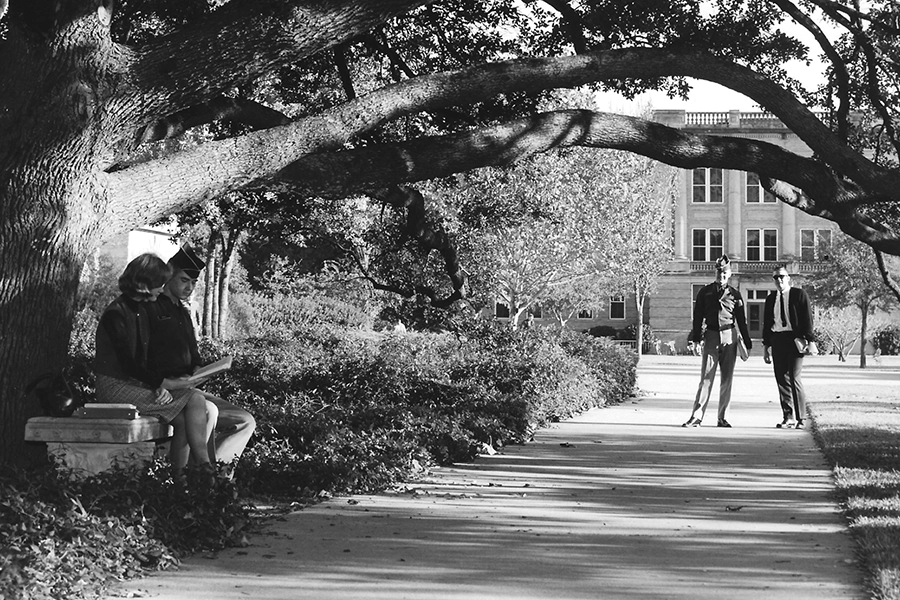 Forrest Mims '66 was photographed under the Century Tree in 1964.
When I chaired the Great Issues Speakers Series in 1965, I met many famous personalities, including German space scientist Wernher von Braun and Mercury astronaut Scott Carpenter, the second U.S. astronaut to orbit the earth. After Carpenter’s talk, I asked if I could ride back with him to Houston that night. He consented, and there followed a two-hour opportunity to spend quality time with an authentic American hero.
He dropped me off in downtown Houston around midnight. Still wearing my Corps of Cadets uniform, I immediately began hitchhiking back to Texas A&M, where I arrived just in time for class the next morning with a memory I have never forgotten. If I could relive that day, I would have borrowed a miniature tape recorder and captured the many words of wisdom from him, the astronaut who famously said “Godspeed, John Glenn” as his partner became the first American to orbit Earth.
Forrest Mims ’66
Seguin, Texas
On the Same Side
The day I’d like to relive is the day of the 1999 Texas A&M vs. University of Texas football game. It was the first game after the Bonfire collapse. My husband, Mark DuLaney ’74, and I had tickets, and we went with friends we knew while we were attending Texas A&M. It was quite an experience to witness a game where everyone was “on the same side” in our grief for those who had died. As I recall, we won and so many people, even the Texas fans, expressed their sympathies for the tragedy.
Pat DuLaney ’76
Las Vegas, Nevada
Preserving the Peace
During my senior year, there was a student group called SWAMP (Students Working Against Many Problems) that wanted to stage a sit-in protest on the grass at the Memorial Student Center (MSC). I was part of the MSC Operations Committee, and I was responsible for the advertising in the kiosks. I permitted them to advertise their protest, despite my personal feelings and objections from others.
The day of the protest arrived, and as the SWAMP group of about 20 students strolled toward the MSC, the entire complex was surrounded by the Corps of Cadets and students locked arm-in-arm. The SWAMP group reached the line, said a few things and immediately turned around.
I was so proud of our university for allowing the protest to happen but also staging a non-violent counter to preserve and respect our sacred tradition.
Clinton Gerst ’85
Bozeman, Montana
Presidential Guest
 Photo courtesy Cushing Memorial Library and Archives
The day I’d relive is my graduation day in 1974. Our ceremony was held in G. Rollie White Coliseum. During my time at Texas A&M, the student body approximately doubled due in large part to the growing number of women students. From my freshman to senior year, there was a noticeable change in how many women students were in my classes. My major was political science, so I took a lot of liberal arts classes, which at the time included more women than engineering or agriculture. The decision to allow women to attend Texas A&M was the most important decision made in the university’s history.
Our commencement speaker on that day was Vice President Gerald R. Ford, who offered many wise words. Three months later, he became president following the resignation of President Richard Nixon. Those were turbulent times, much as today. In rereading Vice President Ford’s speech, which is preserved today at President Ford’s library, I am reminded of how things remain the same while some aspects have changed significantly.
Gene Kornegay ’74
Bryan, Texas
Sacred Traditions
 Photo courtesy Cushing Memorial Library and Archives
I came to Texas A&M from a small midwestern town 1,100 miles from College Station. Before I arrived, the only real knowledge I had was gleaned from the 1968 Cotton Bowl: Texas A&M played football, had a magnificent marching band, had a Corps of Cadets and the cadets wore riding boots. With this scant knowledge, I arrived during a blistering hot August in 1970, a week or so before classes, to learn about uniforms, marching, traditions and campusology before the dreaded sophomores arrived. This was when I learned about Silver Taps: the reason, the preparation, the darkness, the sound and the silence.
Our squadron commander was insistent that his fish fully immerse themselves in these longstanding sacred traditions. His vivid descriptions created images in our heads to regard them as if Moses descended Mt. Sinai carrying the Ten Commandments in one hand and Aggie traditions in the other.
It was with this sense of reverence that our class was first to assemble in the darkness near Sully so we would have an unobstructed view of our first Silver Taps. I discovered calling it “a view” is a misnomer as all that could be seen were shades of gray and blackness. The ceremony was not a visual one; it was aural.
As we assembled, we could hear thousands of feet softly shuffling into place. Right before the ceremony, we could hear the Ross Volunteers form up at the base of the stairs leading to Bolton Hall and then step off. Their slow cadence, enhanced with steel-tapped combat boots, hit the pavement in unison. Bam…a silent pause…bam. A gray line of cadets in class Bs emerged from the blackness of the shade of the great live oak. It was so dark that you could only make out faces of the Ross Volunteers when they were right in front of you.
Then we could hear the soft, almost whispered facing commands of the executive officer moving the squad into firing position for the salute. Three times we heard “Ready, aim, fire,” followed by a deafening report and birds disturbed from their roosts before resettling. And then “Present arms.” Harmonious Taps would be played from the dome of the Academic Building, slowly and solemnly three times. There was a final command of “Parade rest,” then thousands of feet moving students back to their dorms.
This was the moment I began to understand the Aggie Spirit. It was a moment that I forever cherish and try to relive.
William “Jan” Faber ’74
Bryan, Texas
Standing Ovation
It was May 1978, my graduation day at G. Rollie White Coliseum. My wife and mother were there to watch me walk across the stage. The coliseum was PACKED. I was just so excited to get that diploma and get to my new job! By pure dumb luck, I was the last new former student to walk across the stage, and I got a standing ovation. It was a blast!
Jim Roemer ’78
El Campo, Texas
Under Starry Skies
I started classes in College Station right after my high school graduation in summer 1976. I was living in Mosher Hall that summer and met John Halter ’78 in the cafeteria, an electrical engineering major just a year older.
In those days, there was a hilly green space just up the street toward Mosher Hall and adjacent to the Eller Oceanography & Meteorology Building. We would often lie out there at night that summer and stare up at the sky after the day cooled off. One night was especially clear, and we could see a satellite moving overhead across the sky. This was in the days before large, low-altitude commercial satellite constellations.
John was a truly lovely, happy man and always full of wonder — and with an exceedingly fast resting heartrate. Maybe a cardiac specialist would have known that his time was limited.
John was my boyfriend for several years and graduated with two degrees from Texas A&M before getting his doctorate in biomedical engineering from Rice University. I ultimately went off to graduate school in the Boston area. I have kept almost every long letter he wrote me, on engineering paper, during those years. John died in 2004 at age 47 on a bike ride in Houston, right after starting a new company. As long as I’m alive, I will cherish that one night.
Dr. Elaine Wagner ’80
Aledo, Texas
Volunteering at Big Event
I loved the day I volunteered at the Special Olympics through The Big Event!
Dr. Jill (Page) Coleman ’93
Montgomery, Texas