As ESPN’s lead play-by-play commentator covering soccer in Spanish, Fernando Palomo ’95 often posts photos and videos on his YouTube channel and Instagram feed from wherever he’s broadcasting. One day, the 25-year ESPN veteran shared a dispatch from the Bristol, Connecticut, set where he hosts the wildly popular show “Fuera de Juego.” On another, he shared a shot of his Aggie Ring against the backdrop of Wembley Stadium in London before calling the stunning 2-1 upset of Manchester United over Manchester City in the 2024 FA Cup, the world’s oldest national soccer competition. He has posted from Qatar for the 2022 World Cup and from Paris for the 2024 Summer Olympics, among countless other locales.
But it’s the videos shot at his home studio in Connecticut that reveal a perspective of Palomo beyond his consistently spirited and polished presentation of the thousands of soccer matches he has called in both Spanish and English. For in the background, his studio walls and shelves are lined with prized Olympic memorabilia he has lovingly collected over his lifetime. It is Palomo’s passion for the Olympics, sparked while watching Olympic Games and documentaries while growing up in El Salvador, that set him on his journey to become not only a formidable track-and-field competitor for Texas A&M University and his country but also an internationally respected storyteller for athletes and their dreams.
Opening Ceremonies on an Olympic Obsession
Palomo first learned about the Olympics by watching black-and-white documentaries from the celebrated director Bud Greenspan. The games burst into full color in his imagination and on his television with the broadcast of the 1984 Summer Olympics in Los Angeles when he was 11.
He felt deeply moved by how the games united people from all over the world. And he was captivated by the way legendary sports broadcasters such as Al Michaels captured the spirit not just of the competitions but also of the competitors themselves. “They cared about the person behind the uniform,” Palomo recalled. “They made me realize, ‘These are human beings who have a dream, and they’ve worked hard to realize it.’”
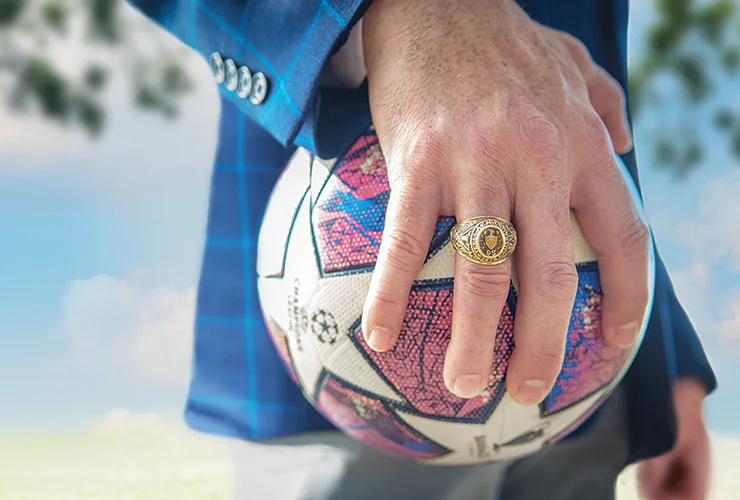 Fernando Palomo ’95 serves as ESPN’s lead play-by-play commentator covering soccer in Spanish. Photo by Matthew Mahon.
Palomo started assembling a scrapbook of every Olympics-related article he could find and began dreaming of becoming an Olympic athlete. He carefully contemplated which sport would allow him the maximum time at the Olympic Games, settling on the decathlon. When he realized he fell short on jumping skills and speed, he focused all his energy on the javelin.
As the 1988 Summer Olympics in Seoul drew near, Palomo was competing on his high school track-and-field team in El Salvador, and his Olympics scrapbook was overflowing. He boldly approached the local television station that would broadcast the Olympics to offer his invaluable information resources in the pre-internet age. “I don’t know what they found more interesting: my scrapbook or that I was so passionate, but they decided to entertain my interest,” he said.
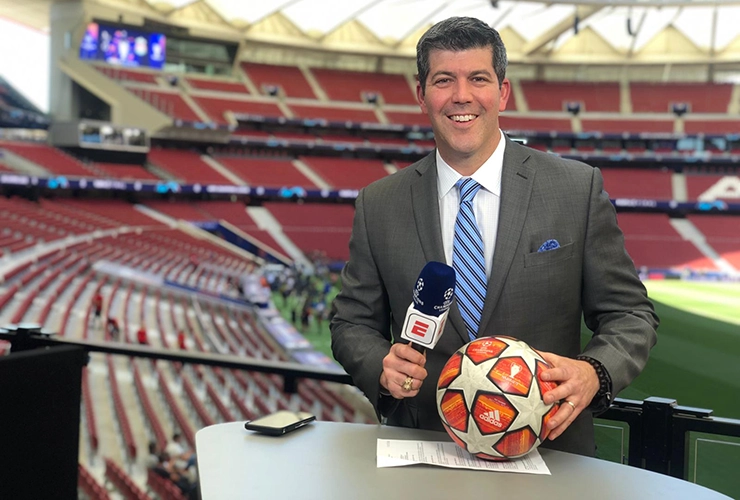 A childhood passion for the Olympic Games eventually led Fernando Palomo ’95 to a successful career in sports broadcasting. Photo provided by Palomo.
After school, he’d rush over to Channel 4 to watch the satellite feeds of the Seoul games unfolding in real time, 15 time zones ahead of him, before the producers assembled their local broadcast. Before school, he’d return to read the newswire and watch more footage. “It fed my desire to be informed,” he said. “I was unconsciously creating this idea that this was going to be my world.”
He continued hanging around the station after the Seoul games closed. When a commentator was needed for a European track circuit during off-peak hours, Palomo eagerly volunteered and was put in front of the microphone. “I was only a junior in high school, so I tried lowering my voice to make it sound older,” he recalled. The most popular sports — soccer and basketball — were claimed by established anchors, but whenever an ancillary sport like swimming needed a commentator, “I would raise my hand,” he said.
"A Place To Belong"
There was no question where Palomo would attend college. His father spent a year at Allen Academy in Bryan, Texas, to improve his English before attending college in the U.S., and two of his six older siblings attended Texas A&M: Eduardo ’82, and Federico ’89. Every time Eduardo returned home, “he would tell stories about Texas A&M and its traditions and bring copies of 12th Man Magazine and The Battalion,” Palomo said. “I was in awe already.”
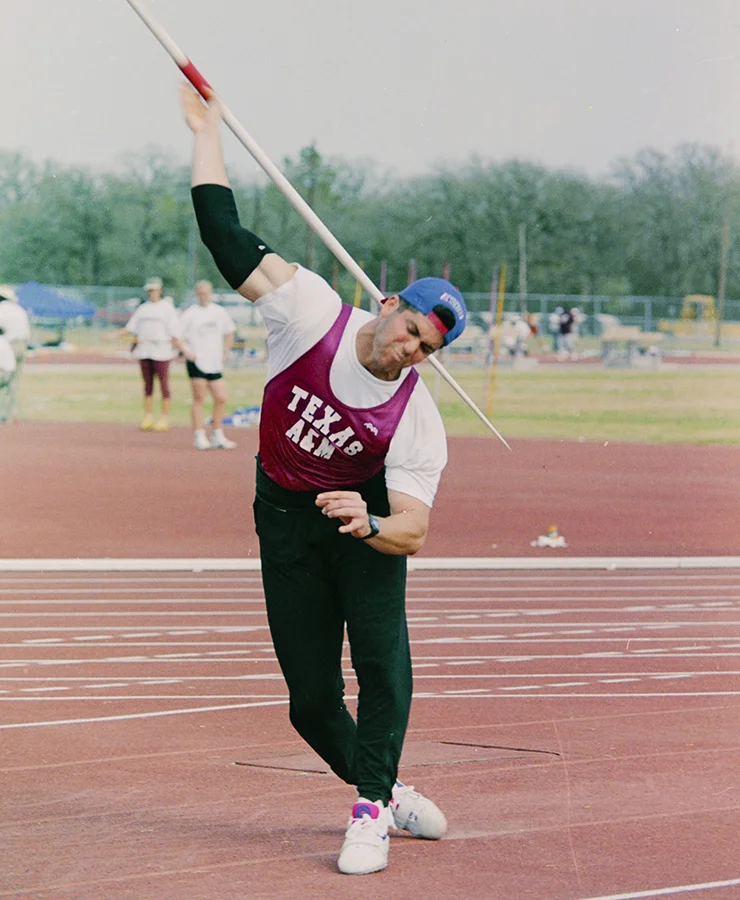 At Texas A&M University, Fernando Palomo ’95 competed on the track and field team and worked toward his own Olympic dreams in the javelin throw. Photo provided by Palomo.
That awe amplified when Federico, his closest brother, joined the Corps of Cadets. Once Palomo started watching the annual Lone Star Showdown between Texas A&M and The University of Texas over Thanksgiving on ESPN, “that’s when it really came together,” he said. “I wanted to be at a school I was passionate about.”
His time at Texas A&M was largely dedicated to his pursuit of his Olympic dream: becoming a world-class javelin thrower. With the same conviction he showed at Channel 4, Palomo approached Texas A&M’s assistant track and field coach Juan De La Garza ’85 ’87 to try out for a walk-on spot on the javelin roster. “I think he saw that passion can overcome athletic deficiencies when you’re willing to put in the extra time and work,” Palomo said.
Under De La Garza’s mentorship, Palomo adopted a disciplined mindset and a schedule of two practices a day. “Juan taught me there is no substitute for today’s workout,” he said. “I became obsessed with trying to be better each day, which I still carry on.” He also learned to strictly compartmentalize his time and focus, a skill that has served him well given his demanding globe-trotting schedule with ESPN. “Whatever I’m doing right now, I’m concentrating on it fully,” he said.
Palomo found a second family within the athletics department and especially among his track and field teammates. He advanced from barely making the travel team as a freshman to earning a partial athletic scholarship his senior year. He was a three-year letterman and a member of the team that competed at the 1996 NCAA Track & Field Championships.
Sometimes during practices, he’d pretend to be the stadium announcer and narrate the race. Then he and his teammates would often sit on the track after practice and talk. “I learned about the U.S. through their eyes, and I became an ambassador of my country,” he said. “My fellow athletes became my fraternity. They gave me a place to belong.”
Finding a New Dream
In 1995, Palomo competed as a member of El Salvador’s national track and field team in the World Championships in Athletics. But despite his strong performances on the field, politics within El Salvador’s national Olympic committee meant he would not be part of their plans for the 1996 Games in Atlanta. “I felt betrayed,” he said. But, with time, he has gained a different perspective on that critical pivot point in his life.
“I had a dream to go the Olympic Games as an athlete. I didn’t make it,” he said. “But the journey that I lived through that intention made me better than I ever imagined, and it led me to where I am now. Had I been closed minded in my interpretation of success, I would have considered myself a failure. I believe that success is defined by who you are at the end of the road that you started.”
I believe that success is defined by who you are at the end of the road that you started.
After returning to El Salvador from College Station in 1997, he continued competing while beginning a career in advertising. In 1998, he threw an El Salvadoran national record in javelin, 72.70 meters, that still stands to this day. But he ultimately leaned into what brought him the greatest joy: his side gig as a sports commentator. He sent out a few resumes, and in 2000, ESPN contacted him to audition as a Spanish-language announcer for NFL games. “It felt unreal,” he said. “I couldn’t believe the worldwide leader in sports called me.”
Palomo credits the father of his new girlfriend at the time, Alexandra — who would become his wife — with giving him the courage to trade his steady advertising job for such an unreal, and unknown, opportunity. “He told me, ‘Follow your gut. If it works, it’s meant to be. If it doesn’t, at least you tried,’” Palomo said.
“I Always Strive To Encapsulate Moments”
Twenty-five years later, Palomo’s broadcasting career has exceeded his wildest dreams. He served as anchor for “SportsCenter” for ESPN Deportes from 2004 to 2006 and has since appeared as a host and analyst across all of ESPN’s soccer studio shows. He has covered five World Cup finals, 12 UEFA Champions League finals, three European Championships and thousands of soccer games across multiple leagues around the globe.
He considers one of his crowning soccer broadcasts to be the extraordinary Champions League final in 2009 in Stadio Olimpico in Rome, a faceoff between Manchester United and its star, Cristiano Ronaldo, versus FC Barcelona and its legend, Lionel Messi. Barcelona clinched the final, 2-0, on its way toward an eventual triple crown. “I always strive to encapsulate moments,” Palomo said. “To put everything into the right words for that game felt amazing.”
Just like the athletes on the field, Palomo puts in tremendous preparation before game time, researching not only every possible scenario on the field but also the teams and players themselves. “I try to tell human stories, just as I saw during the 1984 Olympics,” he said.
As an ESPN broadcaster for 25 years, Fernando Palomo ’95 has covered five Olympic Games, five World Cup finals, 12 UEFA Champions League finals, three European Championships and thousands of soccer games across multiple leagues around the globe. Photos provided by Palomo.
Once kickoff happens, it’s nonstop action, with Palomo deftly passing the “ball” of conversation among his fellow hosts and field reporters, always keeping in mind that the “E” in ESPN stands for entertainment. “If we’re not having fun, it shows,” he said. “So, I try to be as lighthearted as I can and lead by example by showing that I’m passionate about what everybody else is doing.”
He adapts his approach to the language he’s using. “The audience of an English-language soccer broadcast expects it to be slow paced and well spoken,” he said. “Spanish-speaking audiences want you to create a passionate environment from the get-go.” That’s equally true for his role as the Spanish play-by-play voice of EA Sports’ FC video game franchise, which has expanded his reach to the next generation of soccer fans. “It has let me in millions of households around the world and allows me to be the fútbol and soccer voice for millions of children and those young at heart,” he said.
“It’s Bigger Than a Dream”
Palomo’s 11-year-old self emerges whenever he talks about the absolute highlight of his career: covering five Olympic Games. “It’s bigger than a dream,” he said. He has not only called soccer and track-and-field events — including Usain Bolt’s gold medal 100-meter dash at the 2016 Summer Olympics in Rio de Janeiro — but also hosted the Spanish-language broadcast of the opening ceremonies for the 2012 Summer Olympics in London and 2016 Rio Games.
I’m trying to be an ambassador and uphold the good values found in sports: respect for the rules of the game, respect for others and respect for yourself.
“Every day, you wake up so energized because there’s completely different stories to tell,” he said. He pinches himself when in the press box for track-and-field events, working alongside former Olympians-turned-commentators. During the 2012 London Games, he even met his childhood broadcast idol, Al Michaels. “I thanked him for inspiring my sportscasting path,” he recalled.
He relishes spending time in the Olympic Village, snapping photos of athletes with their backs to him to see the names of the countries they represent. “You can see 20 different countries in a single shot,” he said. “That’s what it’s all about: uniting our world and bringing our differences together in one common ground.”
Palomo’s home studio compiles the hundreds of Olympic mementos he has collected over his lifetime: dozens of numbers worn under athletes’ uniforms, dating back to 1972. Commemorative torches from eight Olympics. A baton from the Rio Olympics, signed by Usain Bolt. Plushies of Olympic mascots. And tucked among his Olympic books is his scrapbook that started it all.
His favorite keepsakes from the 2024 Summer Olympics in Paris were the memories he made there with Alexandra and their children, Juan Marcos ’27, Matias ’28 and Valentina. “It was so beautiful to share that Olympic experience with them,” he said.
Telling Meaningful Stories in College Station and Beyond
Now that both of his sons attend Texas A&M, Palomo is thrilled to share the Aggie experience with them beyond the football games and track meets they’ve attended as a family over the years. “I lost my dad when I was 21, so I spent half of my college years without him. Texas A&M did its part to keep me on my path,” he said. “Now that my kids are at school, it’s Texas A&M’s turn to do for them what it did for me.”
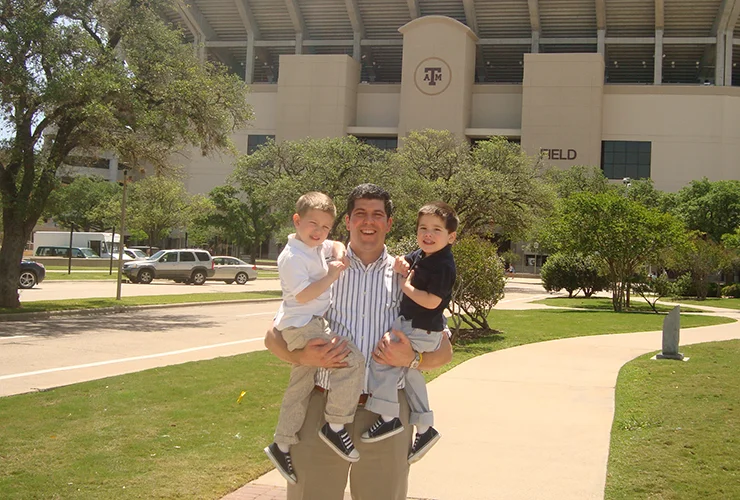 Fernando Palomo ’95 visits Aggieland with his sons Juan Marcos ’27 and Matias ’28 when they were children. Photo provided by Palomo.
As a lifetime member of the Texas A&M Lettermen’s Association and a 2019 inductee to the Department of Agricultural Economics’ Tyrus R. Timm Honor Registry, Palomo eagerly accepts any invitation to return to campus. He has provided pep talks in classrooms and locker rooms, emceed the Texas A&M Athletics Legacy Awards and served as the stadium announcer for a few home track meets. “I’m happy to be part of anything for Texas A&M to stay close to the university and give back to students and the community,” he said.
When Mays Business School Dean Nate Sharp asked Palomo to chair the advisory board for the upcoming MS Sport Business Analytics program, he felt honored. “It’s a great opportunity for the university to develop professionals in areas of the growing sports industry that haven’t been explored yet,” he said.
With the growing sports world comes ever more stories to tell. Palomo is dedicated to continuing to share them. “I’m going to keep feeding my dream of telling the 12-year-olds out there meaningful stories of great people in sports, which come not just from first place or gold medal winners but from everyone who participates,” he said. “I’m trying to be an ambassador and uphold the good values found in sports: respect for the rules of the game, respect for others and respect for yourself.”

Send Message to Jennifer Ann
Thank you for submitting a contact form!
Contact form was unable to submit.