Most people spend the early years of adulthood learning how to navigate difficult choices. They figure out how to weigh consequences, communicate hard truths, and lead through conflict only after work, pressure and mistakes force them to. But at the Hollingsworth Center for Ethical Leadership, housed within the Corps of Cadets, students begin learning those lessons sooner. They enter their careers with instincts and skills many people build only after years on the job.
In Hollingsworth courses, students practice ethical reasoning before the stakes rise. They debate case studies, examine decisions where no option is perfect, and write reflections that require them to pause and look honestly at their intentions. These conversations become rehearsals for the moments that follow them into their careers and help them recognize ethical dilemmas in real time rather than long after the fact.
Former Managing Director Bob Ellithorpe ’85, USMC (Ret.) said that is the purpose of the center. Hollingsworth courses are open to every Aggie, not only cadets, and he believes that broad access is one of the program’s strengths. Students from engineering, business, the liberal arts and many other majors sit beside cadets and work through the same ethical questions. “Leadership cuts across every industry,” Ellithorpe said, “and the Hollingsworth curriculum emphasizes teaching students to lead before they hold positions of authority.”
Classes provide tools for personal development and focus on student mastery of 12 leadership and career readiness competencies, and Aggies can apply their coursework toward a certificate in applied leadership or a new university leadership minor. Because of its emphasis on teaching students why character matters, the center is also a co-leader of the Character pillar under the university’s new Citizens for Good Program designed to prepare students to be contributing citizens of their communities.
Over time, the lessons shaped in Hollingsworth classes settle into habits and instincts. And sooner or later, every student reaches a moment when those conversations turn into choices that matter.
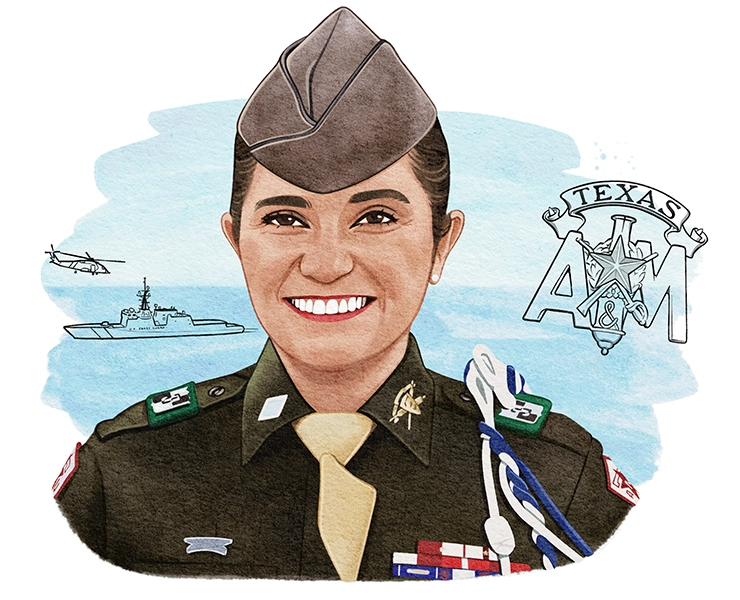 At Texas A&M, Hollingsworth Center courses taught Lt. Andy Lieb ’18 leadership lessons she would carry with her into the U.S. Coast Guard.
Lt. Martha Andrea “Andy” Lieb ’18: Navigating Ethical Waters
For Lt. Martha Andrea “Andy” Lieb ’18, an emergency management specialist with the U.S. Coast Guard, that moment arrived at sea. At the end of a weeks-long patrol, her ship was diverted 300 miles away to respond to a notice about a fisherman who had gone overboard, and after several days of searching with no sign of him, the crew faced a difficult reality: whether to continue the search or return to safety.
While the decision to end the search ultimately rested with the ship’s captain, Lieb was involved in the conversations that led there. As conditions evolved, she helped assess the situation by informing the captain that supplies were running low, the crew had been operating for extended hours and the likelihood of finding the fisherman was diminishing. Continuing the search increased the risk to the crew. Turning back meant accepting that they likely would not find him alive.
Throughout the process, the captain walked Lieb through how to weigh risk, resources and responsibility. Together with other officers, they slowed the conversation, questioned assumptions and talked through the facts. “It was one of the hardest conversations I have ever had,” Lieb said.
Being present shows your people you respect them. Hollingsworth helped me understand that early.
When all the information pointed in one direction, the captain made the call to end the search. The moment stuck with Lieb, because although she didn’t give the final order, she had helped carry the weight of it.
Not only had Lieb never imagined she would face a decision like that, but she had not pictured herself in uniform at all. Growing up in Laredo, Texas, she planned to go to medical school until a friend encouraged her to learn more about the Corps of Cadets at Texas A&M University. The structure, service and sense of purpose appealed to her, and through the Corps she discovered the U.S. Coast Guard. The mission of protecting lives and serving in a role that demanded versatility drew her in.
During her time in the Corps, Lieb enrolled in Hollingsworth courses that shaped how she thinks and leads, teaching her to value the people behind every decision. She learned to slow her pace, ask better questions and recognize when someone needed her presence more than her orders. Those habits became the backbone of her leadership long before she stepped onto a ship.
“Being present shows your people you respect them,” she said. “Hollingsworth helped me understand that early.”
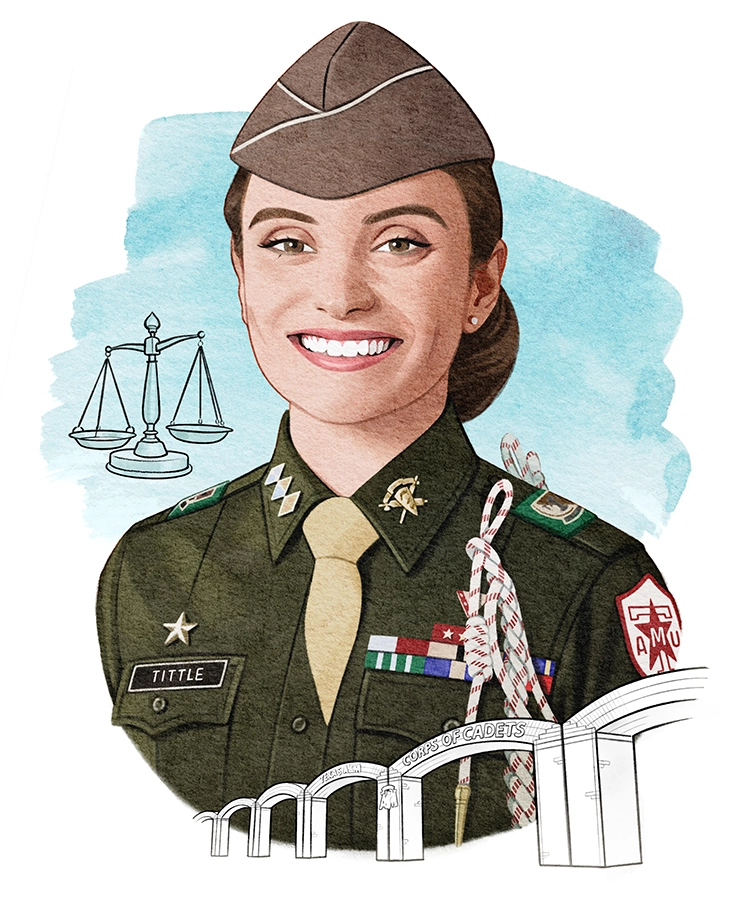 Through the Hollingsworth Center, Anderson Tittle ’22 learned to pause, listen and communicate with intention.
Anderson Tittle ’22: Leadership That Cannot Be Rushed
Like Lieb, Anderson Tittle ’22 learned early that leadership often begins with the discipline to slow down. As a dual JD and MBA student at Baylor University, Tittle faces ethical questions daily. Law school has clear guardrails that mirror the legal profession, while business school often places her in conversations where shortcuts seem tempting. She feels prepared to navigate both, but she first applied Hollingsworth’s lessons while she was still learning them herself.
During her senior year at Texas A&M, Tittle spent nearly 15 hours across two weeks with Dr. Dave Keller ’07, USAF (Ret.) helping redesign the Corps of Cadets’ freshman leadership experience after a difficult COVID year. Hundreds of new cadets would feel the effects of the decisions she helped shape.
“I tend to think and act with a lot of conviction,” she said. She had strong ideas about what needed to change, but Keller asked her to slow down. Together, they walked through each proposal. Who would it affect? How would it land? What value did it bring? How would she explain it in a way that earned trust?
Retired Air Force Col. Kenneth Allison ’85, who was part of those meetings, added a lesson she still uses: Even if your instincts are correct, you are not leading well if you cannot explain your reasoning clearly.
Those hours became the first time she felt the weight of decisions that mattered. They taught her to pause, listen and communicate with intention.
Now, as she balances the demands of law and business, she sees those lessons with greater clarity. “Hollingsworth prepared me for encountering people who think that cutting corners will make you successful, and it gave me the vocabulary and foresight to feel comfortable making the right choice,” she said.
 Sam Gottlich ’21 credits the Hollingsworth Center with teaching him to make ethical decisions where safety and cost intersect.
Sam Gottlich ’21: Choosing Life Over $80,000
Sam Gottlich ’21 was one of the many Aggies who found the Hollingsworth Center without ever putting on a Corps uniform. Majoring in mechanical engineering, he enrolled in a leadership course simply because he wanted a break from problem sets. He had heard his younger brother talk about the conversations happening in the center’s classes, so Gottlich signed up out of curiosity.
Taught by Dr. Darin Paine ’18 USAFR, the class became a pause he didn’t know he needed. The room centered around stories rather than formulas, and Paine grounded abstract concepts in real decisions. Gottlich felt instincts forming that he could not yet name.
At the end of the day, I want to make choices I can live with. Life matters more than cost, and Hollingsworth helped me understand that.
After graduation, Gottlich joined Lockheed Martin as a manufacturing engineer on the F-35 production line. His job required him to examine aircraft components worth up to $80,000 and decide whether to scrap them or send them forward. Each choice balanced cost and safety.
“There were times I had to decide whether to scrap a part worth 80 grand or use it,” he said. “But money is ultimately just money and life is life, and that part could fail in flight.”
The stakes were clear, and he chose safety every time.
He now works at Saronic, an Austin-based startup that designs autonomous boats for the U.S. Navy and commercial use. The environment is different, but ethical questions remain. Gottlich still relies on the habits he built in his Hollingsworth Center class. “At the end of the day, I want to make choices I can live with,” he said. “Life matters more than cost, and Hollingsworth helped me understand that.”
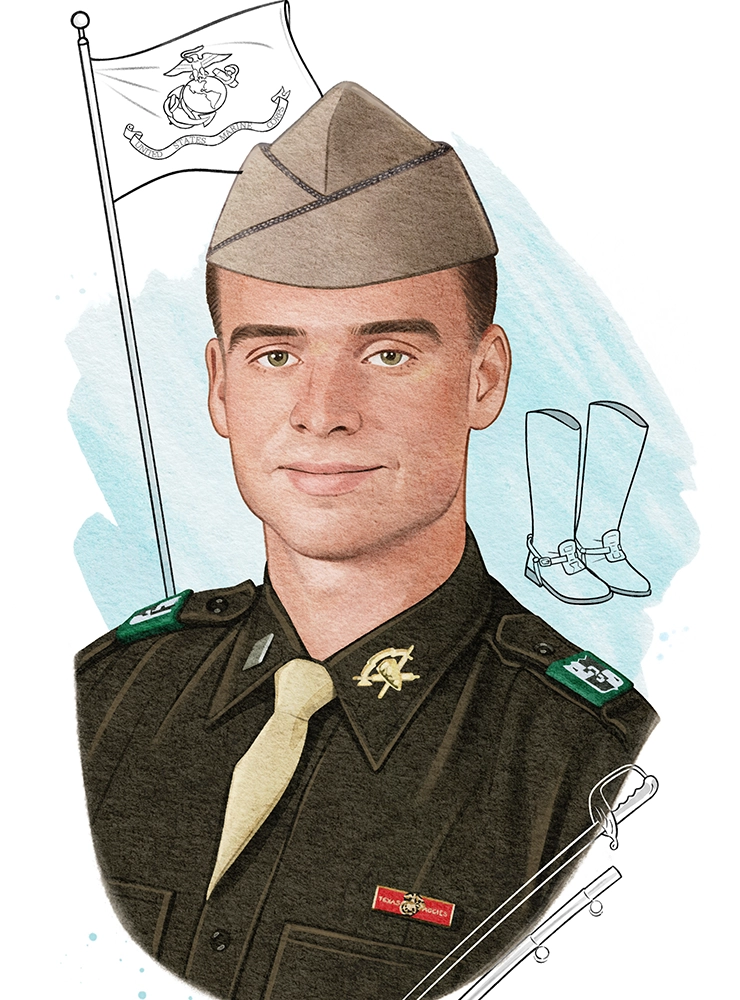 The Hollingsworth Center shaped Lt. Michael Monk ’21 and his leadership philosophy, teaching him to embrace failure and act with integrity.
Lt. Michael Monk ’21: A Lesson Worth Passing
Lt. Michael Monk’s moment of clarity began with a failure he never saw coming. Sitting in his car in a parking lot, he opened the grade report he had been avoiding. A “D” in his Hollingsworth Center course. For a commanding officer like Monk ’21, it was not just a bad grade. It was grounds for removal from the Corps of Cadets. And he knew exactly how it had happened: missed classes, skipped studying and treating school like something to get through rather than something to learn from.
“That was a really big personal failure for me,” he said.
He went into a meeting with the commandant and Keller expecting dismissal. Instead, they gave him one chance to retake the capstone class and let it change him.
Monk accepted. Throughout the semester, he met with Keller weekly. They talked about justice, mercy, accountability and the kind of leader Monk hoped to become. Slowly, the class he once treated lightly became the class that shaped him most.
“If I had to go back to one college class that formed me, it would be that one,” he said.
He carried that clarity into the Marine Corps after commissioning as an infantry officer, where ethical pressure became part of daily life. Leading Marines meant telling the truth even when it exposed him and owning mistakes without hesitation.
“There are moments when you think, ‘I can cover this up, and it will be fine,’” he said. “But I value truth. I want to be truthful, and it ends up being a positive thing because people trust you more.”
Now preparing to transition into ministry and nonprofit work, Monk sees that semester as the moment that redirected his life. The failure that almost removed him from the Corps revealed the leader he wanted to be and the integrity he refuses to compromise.
“Failing that class ended up teaching me more about leadership,” he said. “Hollingsworth showed me that being a leader worth following means owning the truth, including my failures.”