From Chancellor to Student Body President, read on to see how these Aggies in leadership envision the future of our great university.
 Texas A&M's total enrollment across all campuses numbered 81,354 in fall 2025. (Photo by Josh Lewis '14)
Texas A&M University is already home to one of the largest student bodies in the nation. What does the student body look like in 2076, and what standards will guide enrollment?
In 2026, Texas A&M has already reached a scope and scale that I doubt many could have predicted had this story been told 50 years ago while looking forward to today. In retrospect, we’ve done an incredible job of meeting our responsibilities to the state as its population and the demand for higher education boomed.
We are, however, at a precipice where any additional growth will require significant investment in infrastructure to maintain the quality of instruction and experience that we believe are necessary. As we look to the future, this concern will be the primary factor in shaping our enrollment. How can we ethically and effectively serve the largest portion of the state’s students while ensuring that the Aggie experience remains our most valued distinction? While we can’t know exactly what new fields will require instruction by 2076 or what new challenges the campus will be called on to address, our commitment to what sets us apart will be the reason we continue to thrive.
Chris Reed ’11
Associate Vice President for Enrollment Management and Chief Enrollment Officer
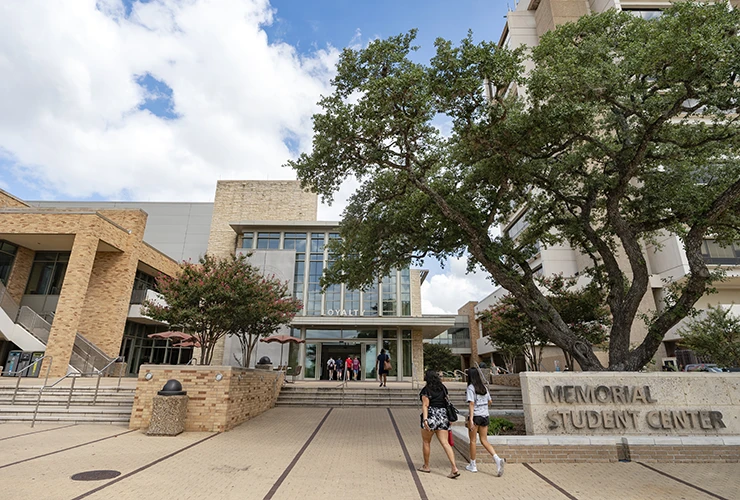 The Memorial Student Center, first dedicated in 1951, continues to welcome visitors to campus and serve as a hub of student activity. (Photo by Laura McKenzie/Texas A&M Marketing and Communications)
What physical changes to campus are expected and what design philosophies will guide them?
We foresee most of the future campus growth on West Campus. Texas A&M recently adopted the West Campus Development Plan, an addendum to the 2017 Campus Master Plan, that provides a roadmap for this growth.
The design philosophies governed by the 2017 plan and influenced by Frederick Giesecke (Class of 1886) and Frederick “Fritz” Hensel Sr. (Class of 1907) focus on the creation of a network of open spaces — quadrangles, plazas and green spaces — alongside pedestrian malls and connectors that unify the campus in both north-south and east-west orientations.
This will maintain the authenticity and uniqueness of place and space while promoting the adaptive re-use of existing buildings. We will maintain and create campus buildings and spaces that continue to inspire and delight while telling our proud campus history by respecting tradition and legacy, enhancing campus identity, and connecting people and place.
Lilia Gonzales ’94 ’97
Texas A&M University Architect
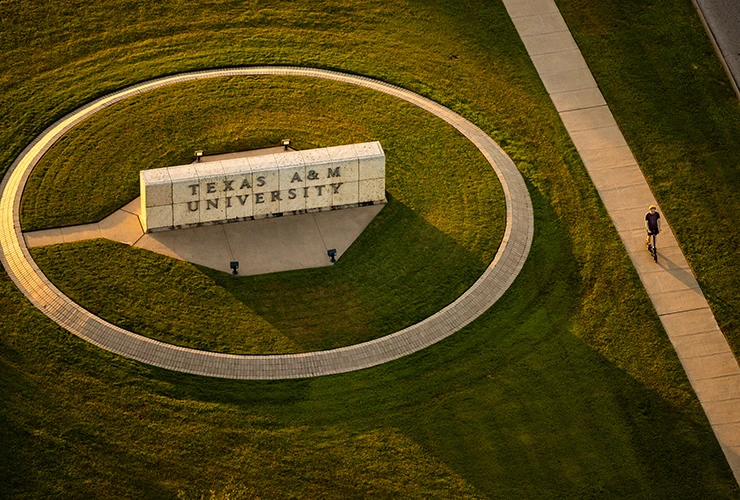 Texas A&M University is the only institution in the state of Texas with a land-, sea- and space-grant designation. (Photo by Will Huffman/Texas A&M Marketing and Communications)
How will Texas A&M carry forward its land-grant mission?
Two centuries after its founding, Texas A&M will remain grounded in the same mission that shaped its first 150 years: to serve Texans through accessible education, innovative research and service to communities across all 254 counties in Texas.
Texas A&M has adapted, adjusted and expanded despite numerous challenges. Deep roots in a strong base of former students, faculty and staff have kept the university true to its mission and will foster the development of a new generation of leaders who create advances in technology beyond our imaginations.
Texas A&M’s future will be defined through its scale and impact by leveraging our multiple campuses, agencies and private sector partnerships. Over the next 50 years, that means expanding access to education for more Texans, wherever they live; translating research into solutions that strengthen communities, industries and national security; and preparing graduates not just for their first job but also for a lifetime of leadership and service.
Glenn Hegar ’93
Chancellor, The Texas A&M University System
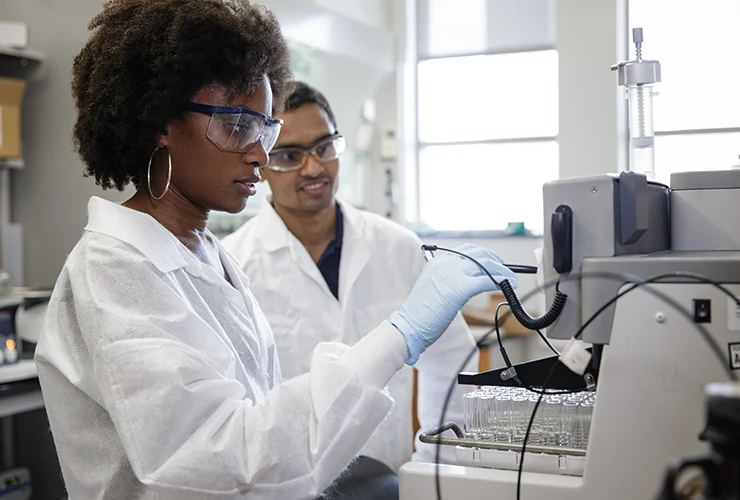 Students and faculty are drawn to Texas A&M's top-tier facilities and ongoing research in health, agriculture, energy and more.
In which of today’s emerging research areas will the university have made a name for itself?
Texas A&M will lead globally in integrating fundamental science with national challenges, grounded in its land-, sea- and space-grant missions. Over the next 50 years, Aggies will help build a research and innovation workforce exceeding half a million.
Texas A&M will lead in quantum science through advances in sensing, materials and secure systems, as well as in microelectronics through resilient manufacturing and supply chains. We will be a leader in energy transitions, including nuclear systems and grid resilience. In the life sciences, Texas A&M will advance synthetic biology and genetic medicine to ensure food security, agricultural resilience and human health. Across these domains, advanced data, modeling and intelligent systems will accelerate discovery and support resilient infrastructure.
The university will also pioneer solutions in water systems, the blue economy and human and robotic space exploration, while strengthening integrated biosecurity. Our defining role will be connecting discovery to deployment across energy, health, food, water and national security.
Dr. Angela Wilson
Vice President for Research
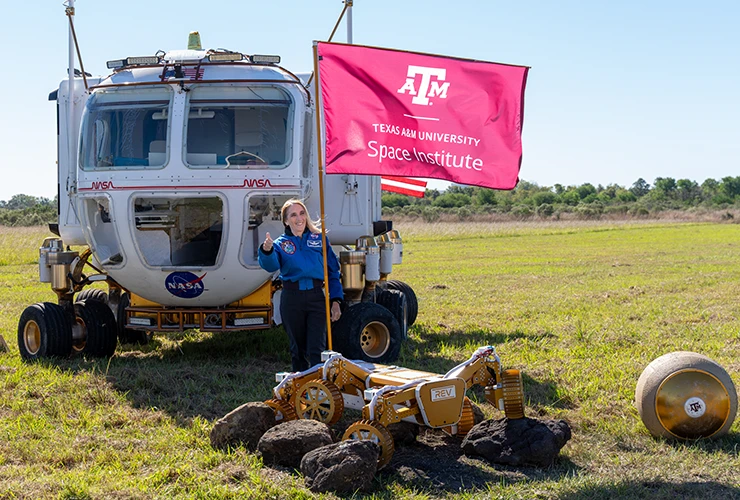 In 2023, the Texas Legislature allocated $200 million for construction of the Texas A&M Space Institute facility next to the Johnson Space Center in Houston. (Photo by College of Engineering)
Texas A&M’s expertise in space research and technology already dominates headlines. What’s on the horizon for the next 50 years?
Texas A&M is widely recognized for its expertise in space research and technology development, encompassing human spaceflight, spacecraft engineering, advanced propulsion and power systems, space robotics, space-based manufacturing, aerospace medicine, in situ resource utilization and space nutrition. The university is also a trusted partner for the U.S. Space Force, leading their institute for in-space operations and new training programs for their personnel, while facilities at the RELLIS Campus support testing and development of next-generation space and hypersonic vehicles, robotics and autonomous systems.
These strengths enable the university to address critical space-related research and development needs over the next fifty years. The Texas A&M Space Institute at Johnson Space Center’s Exploration Park will enable faculty and students from engineering, science, medicine, architecture, agriculture and business to collaborate with industry and government partners to address major challenges in future space exploration. And most importantly, Texas A&M is dedicated to preparing the next generation of scientists, engineers and leaders who will enable future government and commercial space industry initiatives.
Dr. Nancy Currie-Gregg
Director, Texas A&M Space Institute
 The College of Performance, Visualization and Fine Arts is merging design education with technology to help students lead in today's digital age. (Photo by Justin Kling/PVFA)
A unified emphasis on the arts and arts education in Aggieland is relatively new. How will Texas A&M grow as a leader in the arts space?
What we are building in the College of Performance, Visualization and Fine Arts (PVFA) is a place where the future of the visual and performing arts is conceived, explored and translated for impact across all fields.
The immersive experience economy is on the near horizon. Rapidly advancing changes in technology and culture are altering the way we socialize, are entertained and conduct business. Many universities, including Texas A&M, are working on the necessary infrastructure for this change. In PVFA, our focus is on preparing students to create the human experiences enabled by this change.
Our graduates will develop the creative content and the tools for creation. At Texas A&M, we will design and define what our mixed-reality world will look like, sound like and how we move within it. Our students — whether they pursue dance, music, theatre, digital media, performance studies, visual computing or visual arts — are engaged in the transformative exploration and interdisciplinary learning that will fuel these efforts. Guided by our expert faculty and professional staff, we are cultivating paths to artistic and technological innovation, putting Texas A&M in a position to create tomorrow’s cultural fabric and advance our state’s emergent technology economy.
Tim McLaughlin ’90 ’94
Dean, College of Performance, Visualization and Fine Arts
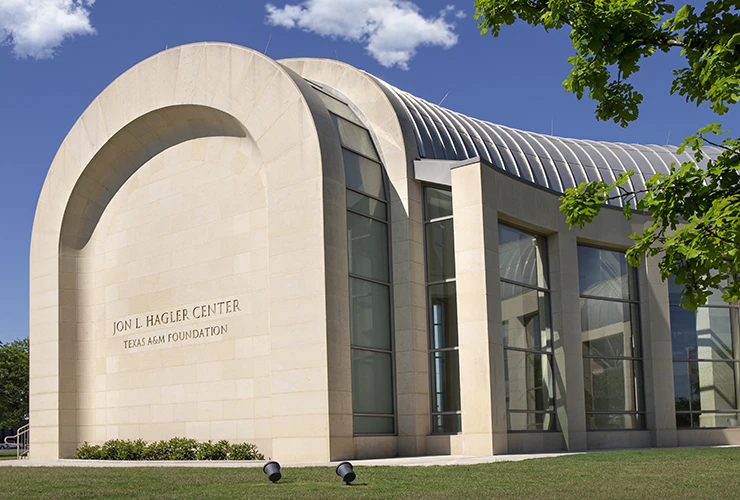 The Jon L. Hagler Center serves as the headquarters of the Texas A&M Foundation, a team of passionate professionals building a brighter future through philanthropy. (Photo by Jim Lyle)
How is the landscape of private philanthropy changing in higher education, and what role will private funds play at Texas A&M five decades from now?
Private philanthropy in higher education is continuing to shift from broad, loyalty‑based giving to strategic, long‑horizon investment. Today’s donors expect value alignment, transparency and a meaningful return on their philanthropic investment. They want to see their generosity solving big societal problems, accelerating innovation and expanding opportunity through the place they love: Texas A&M University. And increasingly, they want institutions willing to help them dream — then dream with them — about what their philanthropy can achieve.
Fifty years from now, private support at Texas A&M will continue to shape the university’s future in ways that extend far beyond traditional philanthropy. Industry partners and donors will play a defining role in generating and advancing the big ideas that move the institution forward, providing the “catalytic capital” that enables Texas A&M to innovate more quickly and tackle the most complex challenges of the next century. The next decades will be shaped by those who believe the most important chapters of this university’s story are still unwritten.
At the Texas A&M Foundation, we are committed to ensuring that this generosity translates into lasting strength for the university. Our role is to steward private support in ways that protect the institution’s long‑term health, preserve its independence and sustain its ability to serve future generations of Aggies. We serve as a strategic partner in Texas A&M's most ambitious ideas, the bridge that gives donors confidence their investment will be protected and deployed with integrity. Our future measure of success won't be dollars raised. It will be whether the university that donors helped build is still expanding opportunity, tackling hard problems and reflecting the values of the people who believed in it.
Chastity Carrigan ’16
Senior Vice President for Development, Texas A&M Foundation
 Traditions like Aggie game day, student organizations and other experiences outside of the classroom unite students, fostering growth and the Spirit of Aggieland. (Photo by Robb Kendrick).
What’s next when it comes to the student experience outside the classroom?
The future of student affairs at Texas A&M is defined by our commitment to shaping a world‑class student experience through honoring Aggie traditions and investing in programs, services and spaces that tomorrow’s students need to thrive.
As we look ahead, we are expanding our vision to include new and enhanced facilities that foster deeper student involvement, engagement, community, and connection of co-curricular and academic experiences, specifically as our West Campus continues to grow. From spaces that support organizations and leadership development to residential environments that enrich on‑campus living, these investments will create hubs of connection for every Aggie.
With the support of former students and donors, we’ll create atmospheres that inspire collaboration, well‑being, traditions, career development and personal growth. Together, we can ensure that Texas A&M remains a place where students feel supported, challenged and empowered throughout their journey. By strengthening the heart of campus life, we will prepare the next generation of leaders who will carry the Aggie Spirit into the future.
Dr. Bill Kibler ’91
Vice President for Student Affairs
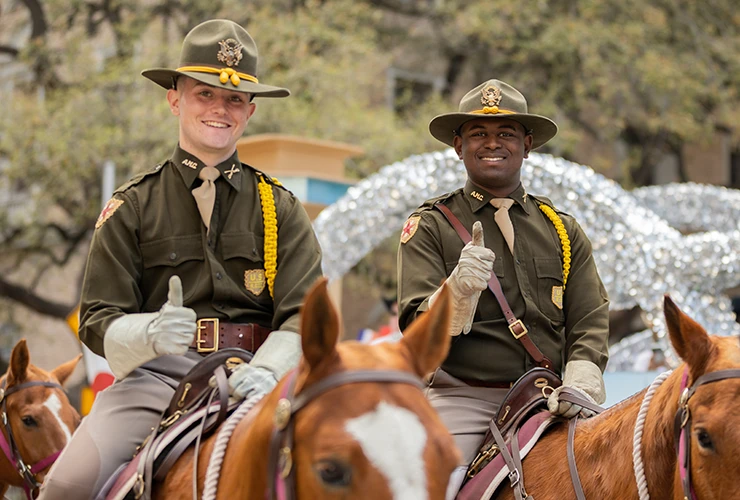 Creating exceptional leaders since 1876, the Corp of Cadets proudly trains over 2,400 students today for lives of service and honor. (Photo provided by Corps of Cadets)
And what’s the vision for the Corps of Cadets in 50 years?
For 150 years, the Corps of Cadets has stood as the heartbeat of Texas A&M through its time-honored traditions and legendary spirit. Our Corps has produced generations of leaders who have made significant contributions to our communities, state and nation.
The 50-year vision is a Corps that has maintained the challenge of membership while expanding developmental opportunities. Whether in the military, public service or private sphere, the Corps of Cadets will remain the premier path for young leaders who seek a challenge and aspire to become a better version of themselves in the process.
Whenever our nation has called, Texas Aggies have answered. The proof is written in history. In the next 50 years and beyond, we will continue to produce well-educated leaders of character who can confidently answer the call to serve.
Lt. Gen. James “Chip” Bierman Jr.
Corps Commandant
 Muster brings Aggies together every April 21st to remember and honor those who have passed away during the previous year. (Photo by Abbey Toronjo, TAMU Marcomm)
How will the university’s long‑standing traditions endure and remain relevant?
Texas A&M’s traditions have long endured due to the shared core values and outstanding character of students throughout time. From daily traditions, such as greeting each other with a “Howdy,” to standing shoulder to shoulder on April 21 to reply “Here,” students remain connected due to “the spirit can ne’er be told.” There is a unique and unexplainable nature to the culture at Texas A&M, and the spirit upheld by students, both now and in the future, will forever keep this a special place.
Our university’s longest standing tradition is not one tangible act but instead the dedication carried out by each and every student to be part of something greater than themselves. This spirit is what makes this university a great university, one rooted in a life of selfless service and in Aggies’ willingness to stand beside one another for all their days. As generations of Aggies come and go, there will always be a bond that encourages students to embrace the Spirit of Aggieland.
Paige Pesek ’27
Chair, Traditions Council
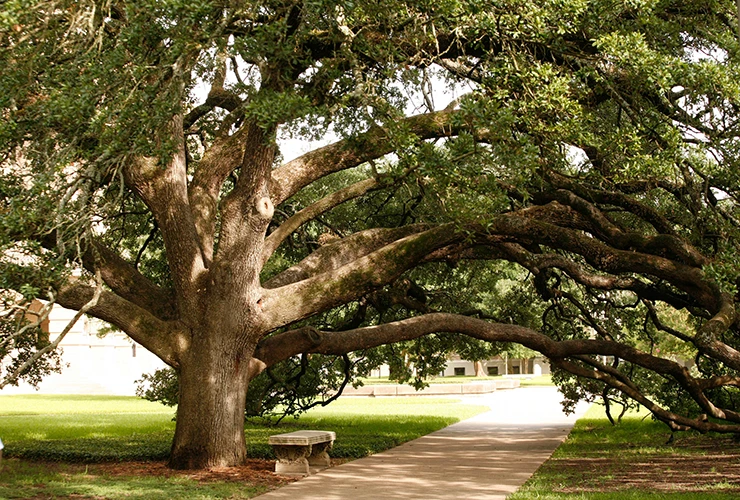 The legendary Century Tree is approximately 135 years old and registered under the Texas Forest Service's "Famous Trees of Texas."
And just for fun: What dining hall food should definitely survive, and what campus legend should never go away?
That’s easy! In 50 years, I hope students will still look forward to Fried Chicken Tuesday at Duncan Dining Hall, accompanied by collard greens and mashed potatoes. Nothing beats it!
As for the campus legend, I hope Aggies will still believe that if you walk under the Century Tree as a couple, you’re destined to marry. How sweet is that?
Duncan Poling ’27
2026-27 Student Body President

Send Message to Lydia
Thank you for submitting a contact form!
Contact form was unable to submit.